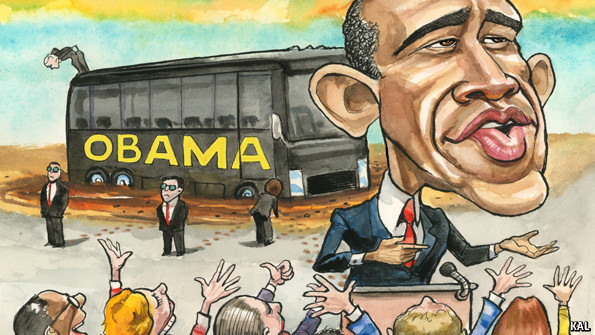
Obama's Dilemma
Published in Braunschweiger Zeitung
(Germany) on 28 August 2013
by Friedemann Diederichs (link to
original)
In view of vigorous saber-rattling, a military intervention in Syria seems imminent. The rationale and legality of such action can be contested, but one thing in particular seems to play barely a role in this coalition of the willing: the question of afterwards.
The White House has made it clear that there would be only limited retaliation. The sole purpose would be deterrence and the obstruction of further poison gas use by the Syrian regime. Additionally, it should serve as a message to other despots. The Syrian dictator, Bashar al-Assad, will not come under fire. Regime change is not a goal of the attack.
But will Assad be impressed by a largely symbolic action? For the bloody civil war, which has so far claimed over 100,000 lives and eschewed any political solution, it could mean this: It will go on unabated. And that would serve only to prove one thing: The West, which has observed the Syrian dilemma for two years without any coherent understanding, will still be at a loss when the dust clears.
For Barack Obama, a more personal question accompanies the one of a political strategy in Syria: Yesterday was the memorial for black activist and Nobel Peace Prize winner Martin Luther King, Obama’s personal hero and role model. If he supports military action in Syria, Obama will have to solve the clear contradiction: How can a show of force, in all likelihood without a U.N. mandate, resolve itself both with his conscience and his reverence for a historical figure who, like Mahatma Gandhi, always preached nonviolence in his quest to overcome racial barriers?
The White House has made it clear that there would be only limited retaliation. The sole purpose would be deterrence and the obstruction of further poison gas use by the Syrian regime. Additionally, it should serve as a message to other despots. The Syrian dictator, Bashar al-Assad, will not come under fire. Regime change is not a goal of the attack.
But will Assad be impressed by a largely symbolic action? For the bloody civil war, which has so far claimed over 100,000 lives and eschewed any political solution, it could mean this: It will go on unabated. And that would serve only to prove one thing: The West, which has observed the Syrian dilemma for two years without any coherent understanding, will still be at a loss when the dust clears.
For Barack Obama, a more personal question accompanies the one of a political strategy in Syria: Yesterday was the memorial for black activist and Nobel Peace Prize winner Martin Luther King, Obama’s personal hero and role model. If he supports military action in Syria, Obama will have to solve the clear contradiction: How can a show of force, in all likelihood without a U.N. mandate, resolve itself both with his conscience and his reverence for a historical figure who, like Mahatma Gandhi, always preached nonviolence in his quest to overcome racial barriers?
Next article