
Wall on the Border
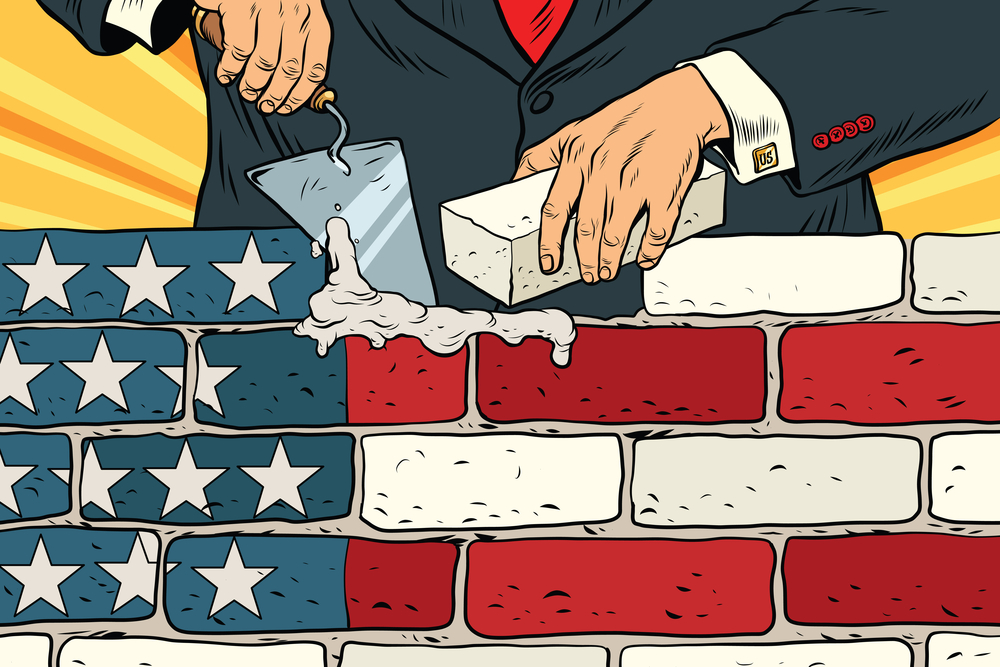
On Friday, Feb. 15, President Donald Trump declared a national emergency with the intention of increasing funding for the repair and new construction of a wall on the border with Mexico. In this way, he intends to re-allocate $8 billion from the military budget. This is a matter of maintaining the election ruse that produced results in the 2016 presidential election, in which the mean-spirited discourse of fear of others prevailed and an isolationist vision was promoted.
As we know, one of the principal ideas of the 2016 Trump presidential campaign was the proposal to build a 3,200 km wall (approximately 1,988 miles) along the border with Mexico. Later, he spelled out his promise and proposed strengthening and building a wall only half that length because the rest of the border, it was said, was already protected by natural barriers (mountains and rivers).
According to the BBC, before Trump’s presidency, a little more than 1,000 km (approximately 621 miles) of barriers existed along Mexico’s northern border. Of that, 570 km (approximately 354 miles) consist of fences constructed to control or inhibit the passage of pedestrians and 483 km (approximately 300 miles) to monitor the passage of vehicles. The greater portion of these barriers runs along the border with the states of California, Arizona and New México. If we consider the fencing already built along with the natural barriers, the length of the new wall to be constructed would be 600 km (approximately 373 miles).
Still, despite the fact that since Trump’s inauguration Congress has earmarked $1.7 million to lengthen or renovate 200 km of wall (approximately 124 miles), the current barriers have not been increased; only 64 km (approximately 40 miles) are being renovated.* The start of construction on the first 23 km of extended barriers (approximately 14 miles) is planned this month in the Rio Grande Valley, Texas.
The range of cost estimates for extending and strengthening the wall is very broad, from Trump’s announcement, in 2017, that it would cost between $8 billion and $12 billion, to the one put forward by the Department of Homeland Security of around $25 billion.
Moreover, the president bases his position on two false premises: he maintains that lengthening the barriers would stop the flow of drugs and stem the immigration of criminals across the border.
Regarding the flow of drugs, Trump has said that 90 percent of drugs in the U.S. cross the border. In contrast, only 39 percent of heroin was secured at the border in 2017, according to data from the Drug Enforcement Administration.. That is, only a small percentage of the amount seized occurred in places where barriers exist or for which barriers are proposed. The DEA maintains that the greater volume of drugs enters through legal ports of entry. That is to say, the strengthening and expansion of the wall would have a minimal effect on the containment of drug trafficking.
Regarding immigration, official data show that the number of detentions on the border has declined substantially since 2000. In that year, the number of detentions was1,600,000, while in 2018, it was less that 400,000.
Additionally, official U.S. statistics show that a high proportion of illegal immigration occurs with people who originally entered on a visa. At the beginning of 2018, more than 700,000 people that entered the United States failed to comply with the terms of their visa. The greatest number (100,000) are from Canada, followed distantly by Mexico (50,000) and China (a little more than 40,000). That means that illegal immigration has its greatest ally in the fact that people are violating terms of temporary legal entry. Strengthening the wall will not stop that kind of illegal immigration.
Despite President Trump’s continual and vigorous spread of propaganda, the majority of U.S. citizens (58 percent) oppose the expansion of the wall, while 40 percent support it, according to the results from a survey by the Pew Research Center.
Faced with that finding, the Democratic faction in Congress has announced its opposition to Trump’s declaration of a national emergency, and has challenged it by various means. At the same time, the governors and attorneys general of the states of California and New York have announced that they will oppose the measure in the courts. If that is the case, the U.S. Supreme Court will decide the matter (with an apparent majority favorable to Trump).
Regardless of the origin and election-based nature of the national emergency declaration, there is a risk that it will have dangerous economic consequences for states on both sides of the border and for both nations. It should not be forgotten that two state economies (California and Texas), pillars of the U.S. economy, clearly benefit from border trade.
That also explains why in some cities, such as El Paso, Texas, the civil movement against the wall is not insignificant.
*Editor’s note: The author may have misstated the amount of money spent on the border wall since Trump’s inauguration as $1.7 million, as reports indicate that figure may have been closer to $1.7 billion.
As we know, one of the principal ideas of the 2016 Trump presidential campaign was the proposal to build a 3,200 km wall (approximately 1,988 miles) along the border with Mexico. Later, he spelled out his promise and proposed strengthening and building a wall only half that length because the rest of the border, it was said, was already protected by natural barriers (mountains and rivers).
According to the BBC, before Trump’s presidency, a little more than 1,000 km (approximately 621 miles) of barriers existed along Mexico’s northern border. Of that, 570 km (approximately 354 miles) consist of fences constructed to control or inhibit the passage of pedestrians and 483 km (approximately 300 miles) to monitor the passage of vehicles. The greater portion of these barriers runs along the border with the states of California, Arizona and New México. If we consider the fencing already built along with the natural barriers, the length of the new wall to be constructed would be 600 km (approximately 373 miles).
Still, despite the fact that since Trump’s inauguration Congress has earmarked $1.7 million to lengthen or renovate 200 km of wall (approximately 124 miles), the current barriers have not been increased; only 64 km (approximately 40 miles) are being renovated.* The start of construction on the first 23 km of extended barriers (approximately 14 miles) is planned this month in the Rio Grande Valley, Texas.
The range of cost estimates for extending and strengthening the wall is very broad, from Trump’s announcement, in 2017, that it would cost between $8 billion and $12 billion, to the one put forward by the Department of Homeland Security of around $25 billion.
Moreover, the president bases his position on two false premises: he maintains that lengthening the barriers would stop the flow of drugs and stem the immigration of criminals across the border.
Regarding the flow of drugs, Trump has said that 90 percent of drugs in the U.S. cross the border. In contrast, only 39 percent of heroin was secured at the border in 2017, according to data from the Drug Enforcement Administration.. That is, only a small percentage of the amount seized occurred in places where barriers exist or for which barriers are proposed. The DEA maintains that the greater volume of drugs enters through legal ports of entry. That is to say, the strengthening and expansion of the wall would have a minimal effect on the containment of drug trafficking.
Regarding immigration, official data show that the number of detentions on the border has declined substantially since 2000. In that year, the number of detentions was1,600,000, while in 2018, it was less that 400,000.
Additionally, official U.S. statistics show that a high proportion of illegal immigration occurs with people who originally entered on a visa. At the beginning of 2018, more than 700,000 people that entered the United States failed to comply with the terms of their visa. The greatest number (100,000) are from Canada, followed distantly by Mexico (50,000) and China (a little more than 40,000). That means that illegal immigration has its greatest ally in the fact that people are violating terms of temporary legal entry. Strengthening the wall will not stop that kind of illegal immigration.
Despite President Trump’s continual and vigorous spread of propaganda, the majority of U.S. citizens (58 percent) oppose the expansion of the wall, while 40 percent support it, according to the results from a survey by the Pew Research Center.
Faced with that finding, the Democratic faction in Congress has announced its opposition to Trump’s declaration of a national emergency, and has challenged it by various means. At the same time, the governors and attorneys general of the states of California and New York have announced that they will oppose the measure in the courts. If that is the case, the U.S. Supreme Court will decide the matter (with an apparent majority favorable to Trump).
Regardless of the origin and election-based nature of the national emergency declaration, there is a risk that it will have dangerous economic consequences for states on both sides of the border and for both nations. It should not be forgotten that two state economies (California and Texas), pillars of the U.S. economy, clearly benefit from border trade.
That also explains why in some cities, such as El Paso, Texas, the civil movement against the wall is not insignificant.
*Editor’s note: The author may have misstated the amount of money spent on the border wall since Trump’s inauguration as $1.7 million, as reports indicate that figure may have been closer to $1.7 billion.
Previous article

Next article
