Trump and Providence
Published in El Nacional
(Dominican Republic) on 19 October 2020
by Luis Perez Casanova (link to
original)
There is unusual enthusiasm in how Americans approach their November elections; it contrasts with the traditional apathy of the average voter, much like how the pandemic has ridiculed their leader during the current crisis.
The United States became a world leader after the dissolution of the Soviet Union thanks to its military and economic power. Today, under Donald Trump’s leadership, not only does it share the throne with China, but the scientific advancement Trump has promoted has also been overshadowed. Several countries have a vaccine against COVID-19, while Trump and his motley crew are still churning out propaganda.
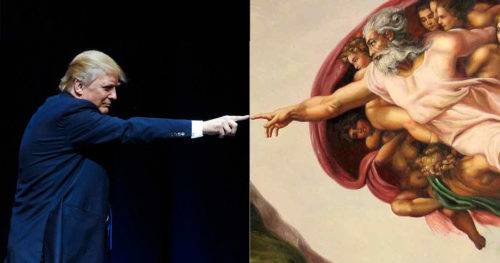
It also looks like Trump has confronted the fact that his able rival Joe Biden is leading by using the fact that Trump was a COVID-19 victim in order to appeal to voters, using faith, as is fitting for the United States’ biggest believer. His rapid recovery from a disease he didn’t believe existed and his general refusal to implement World Health Organization measures alongside advice from key specialists was not due to science or medicine, but rather, a blessing from God.
This approach, combined with threats and other explosive ingredients that have shaped this atypical election campaign, doesn’t seem as casual as it did when he accused Biden of being a socialist during the debate — which is nearly on the same level as being an atheist.
It’s also clear that this time, Trump has everything to lose. It doesn’t matter that Biden looks younger or is promising a fresh and restorative image. In 2016, the Electoral College chose Trump.
He lost the popular vote to Democrat Hillary Clinton by more than 3 million votes, but he won in the Electoral College where he got those 270 votes, just over half of the 538 delegates needed for a victory. Even without the outside criticism and a health crisis that has taken the lives of more than 219,000 people and infected more than 8,000, the predictions are somber for the incumbent.
The recent racial tension which kicked off a series of protests, have also affected Trump’s image — but not as much as his obvious mistakes in dealing with the pandemic, which has put America in the lead for most people infected or dead due to COVID-19.
His Democratic rivals have used these errors as their main weapon. The economic relief that was provided to the unemployed has worked to Trump's advantage, but as the polls say, it hasn’t been enough to change the voters' outlook. This is the moment when providence will be his saving grace.
The United States became a world leader after the dissolution of the Soviet Union thanks to its military and economic power. Today, under Donald Trump’s leadership, not only does it share the throne with China, but the scientific advancement Trump has promoted has also been overshadowed. Several countries have a vaccine against COVID-19, while Trump and his motley crew are still churning out propaganda.
It also looks like Trump has confronted the fact that his able rival Joe Biden is leading by using the fact that Trump was a COVID-19 victim in order to appeal to voters, using faith, as is fitting for the United States’ biggest believer. His rapid recovery from a disease he didn’t believe existed and his general refusal to implement World Health Organization measures alongside advice from key specialists was not due to science or medicine, but rather, a blessing from God.
This approach, combined with threats and other explosive ingredients that have shaped this atypical election campaign, doesn’t seem as casual as it did when he accused Biden of being a socialist during the debate — which is nearly on the same level as being an atheist.
It’s also clear that this time, Trump has everything to lose. It doesn’t matter that Biden looks younger or is promising a fresh and restorative image. In 2016, the Electoral College chose Trump.
He lost the popular vote to Democrat Hillary Clinton by more than 3 million votes, but he won in the Electoral College where he got those 270 votes, just over half of the 538 delegates needed for a victory. Even without the outside criticism and a health crisis that has taken the lives of more than 219,000 people and infected more than 8,000, the predictions are somber for the incumbent.
The recent racial tension which kicked off a series of protests, have also affected Trump’s image — but not as much as his obvious mistakes in dealing with the pandemic, which has put America in the lead for most people infected or dead due to COVID-19.
His Democratic rivals have used these errors as their main weapon. The economic relief that was provided to the unemployed has worked to Trump's advantage, but as the polls say, it hasn’t been enough to change the voters' outlook. This is the moment when providence will be his saving grace.
Previous article
/https://www.thestar.com/content/dam/thestar/opinion/editorials/2020/10/30/after-trump-america-faces-a-long-road-back-to-basic-decency/biden_trump.jpg "After Trump, America Faces a Long Road Back to Basic Decency")
Next article