
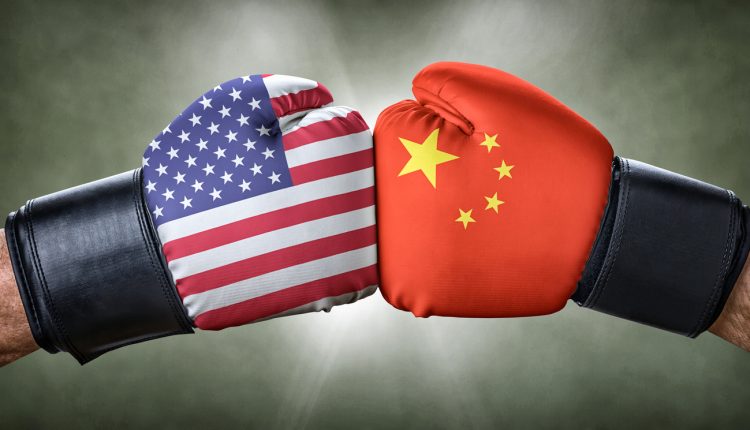
Power Games: US vs. China
The relationship between China and the United States continues to deteriorate. The two countries are opposed on geopolitical issues, digital technology and business, now dominated by global value chains that have complicated the relationship between them. This new global competition will not be like the last century's Cold War; it will be more fluid and nuanced than the struggle between the U.S. and the Soviet Union, for one thing, because, in the 20th century, many countries were clearly allied with one side or the other. Today, the majority of countries have complex relationships with the U.S. and China, and almost all of them desire a combination of security and economic benefits from them both.
Through this confrontation, the Trump administration managed, with its protectionist measures, to reduce its commercial deficit with China from $418 billion to $345.2 billion between 2018 and 2019, according to statistics from the U.S. Census Bureau. Nevertheless, in the midst of the pandemic, China's strength has rebounded and, in the first five months of the year, it exported $143.6 billion in trade to the U.S. and only imported $40.2 billion, obtaining a surplus of $101.4 billion. That equation does not appear to favor the U.S. In addition, while the Chinese economy declined by 6.8% in the first quarter, in the second it grew by 3.2%, which is to say that it effectively achieved a V-shaped recovery. For the U.S., the story was different. According to statistics from The Conference Board, the U.S. economy decreased by 5% in the first quarter and in the second, it is estimated that the decline may be as much as 38%. The expectation is that the first half of the year will close with a decrease of 22%.
Conversely, China’s recovery shows its government's success in controlling the COVID-19 outbreak with widespread testing and travel restrictions. Furthermore, the rebound shows the importance of government spending on highway construction, railroad lines and other infrastructure projects to stimulate the economy, as well as the focused investment by the Chinese business sector when faced with weakness in the area of internal consumption. That presents us with an interesting question: Will the growth of China become the engine necessary to take the global economy out of a depression?
In this debate, Donald Trump will seek to include Latin America, as he already has with Mexico, with which he had a trade deficit of $101.4 billion in 2019 and an estimated $35 billion in the first five months of 2020. One of the areas of discussion will be the successor to Roberto Azevedo, the current director-general of the World Trade Organization, in order to ensure that it will be someone who supports bilateral restrictions. Since he became president, Trump has launched criticism at the institution, seeking to have it validate the trade restrictions imposed by the U.S. Azevedo's succession is planned for the end of August. Among the candidates are Jesús Seade Kuri of México, Ngozi Okonjo-Iweala of Nigeria, Abdel-Hamid Mamdouh of Egypt, Tudor Ulianovschi of Moldavia, Yoo Myung-hee of South Korea, Amina Mohamed of Kenya, Mohammad Maziad al-Tuwaijri of Saudi Arabia and Liam Fox of the United Kingdom. Their plans of action were presented on July 15 and 16 of this year.
The cards have been dealt, but are, we might say, marked, since the Korean candidate, being minister of commerce in Korea, was able to establish the China-South Korea Free Trade Agreement, while the Mexican candidate joined the negotiations for the United States-Mexico-Canada Agreement. Both would have the experience of negotiating with the most powerful countries, but not always with a multilateral vision.
Nevertheless, in their presentations the candidates supported the multilateral vision of the WTO. Still, only two candidates addressed restrictive trade practices. Fox of the United Kingdom proposed reversing these trade practices because the Group of 20 industrial and emerging-market nations’ restrictive trade measures doubled every two years, so that imports linked to this type of practice reached 10.3% of world trade. Mohamed, the Kenyan representative, argued that it is evident that because of the pandemic, the WTO requires reforms, noting that the Great Depression grew deeper because of trade restrictions, and because of that, it is the WTO's responsibility to keep these restrictive practices from being implemented and to prevent the crisis from deepening. From that perspective, what is in play is a great restructuring of real power, and with that the future of world trade. We hope that the power games allow for a more multilateral economy that will benefit those who have participated the least in this great restructuring of world power.
Through this confrontation, the Trump administration managed, with its protectionist measures, to reduce its commercial deficit with China from $418 billion to $345.2 billion between 2018 and 2019, according to statistics from the U.S. Census Bureau. Nevertheless, in the midst of the pandemic, China's strength has rebounded and, in the first five months of the year, it exported $143.6 billion in trade to the U.S. and only imported $40.2 billion, obtaining a surplus of $101.4 billion. That equation does not appear to favor the U.S. In addition, while the Chinese economy declined by 6.8% in the first quarter, in the second it grew by 3.2%, which is to say that it effectively achieved a V-shaped recovery. For the U.S., the story was different. According to statistics from The Conference Board, the U.S. economy decreased by 5% in the first quarter and in the second, it is estimated that the decline may be as much as 38%. The expectation is that the first half of the year will close with a decrease of 22%.
Conversely, China’s recovery shows its government's success in controlling the COVID-19 outbreak with widespread testing and travel restrictions. Furthermore, the rebound shows the importance of government spending on highway construction, railroad lines and other infrastructure projects to stimulate the economy, as well as the focused investment by the Chinese business sector when faced with weakness in the area of internal consumption. That presents us with an interesting question: Will the growth of China become the engine necessary to take the global economy out of a depression?
In this debate, Donald Trump will seek to include Latin America, as he already has with Mexico, with which he had a trade deficit of $101.4 billion in 2019 and an estimated $35 billion in the first five months of 2020. One of the areas of discussion will be the successor to Roberto Azevedo, the current director-general of the World Trade Organization, in order to ensure that it will be someone who supports bilateral restrictions. Since he became president, Trump has launched criticism at the institution, seeking to have it validate the trade restrictions imposed by the U.S. Azevedo's succession is planned for the end of August. Among the candidates are Jesús Seade Kuri of México, Ngozi Okonjo-Iweala of Nigeria, Abdel-Hamid Mamdouh of Egypt, Tudor Ulianovschi of Moldavia, Yoo Myung-hee of South Korea, Amina Mohamed of Kenya, Mohammad Maziad al-Tuwaijri of Saudi Arabia and Liam Fox of the United Kingdom. Their plans of action were presented on July 15 and 16 of this year.
The cards have been dealt, but are, we might say, marked, since the Korean candidate, being minister of commerce in Korea, was able to establish the China-South Korea Free Trade Agreement, while the Mexican candidate joined the negotiations for the United States-Mexico-Canada Agreement. Both would have the experience of negotiating with the most powerful countries, but not always with a multilateral vision.
Nevertheless, in their presentations the candidates supported the multilateral vision of the WTO. Still, only two candidates addressed restrictive trade practices. Fox of the United Kingdom proposed reversing these trade practices because the Group of 20 industrial and emerging-market nations’ restrictive trade measures doubled every two years, so that imports linked to this type of practice reached 10.3% of world trade. Mohamed, the Kenyan representative, argued that it is evident that because of the pandemic, the WTO requires reforms, noting that the Great Depression grew deeper because of trade restrictions, and because of that, it is the WTO's responsibility to keep these restrictive practices from being implemented and to prevent the crisis from deepening. From that perspective, what is in play is a great restructuring of real power, and with that the future of world trade. We hope that the power games allow for a more multilateral economy that will benefit those who have participated the least in this great restructuring of world power.
Previous article

Next article
