
Attack on Girls’ School in Iran: Outdated US Military Intelligence Led to a Deadly Mistake
The U.S. appears to be responsible for the deaths of 170 schoolgirls at an Iranian elementary school. Protecting civilians is not a priority.
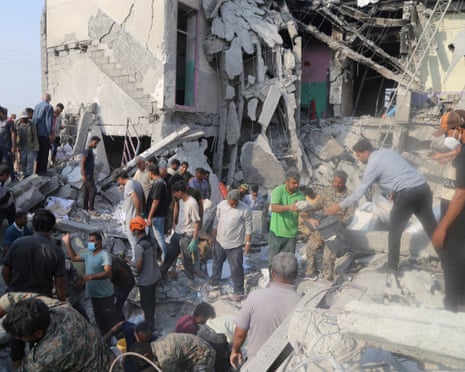
What so far has only been reported by a few media outlets now appears to have been confirmed by internal U.S. military investigations: The United States is responsible for the attack on a girls’ elementary school in the small southern Iranian town of Minab in the very first hours of the war launched by the U.S. and Israel.
CNN and The New York Times reported that apparently outdated Defense Intelligence Agency data were responsible for the incident, citing sources familiar with the investigation. The elementary school was attacked with Tomahawk missiles on Feb. 28, and Iranian officials said about 170 children and 14 teachers were killed.
Until about 10 years ago, the school was in fact part of a military complex used by the Revolutionary Guard. Only afterward were the buildings separated and put to civilian use. However, as The New York Times showed, this has been fairly easy to recognize in satellite imagery ever since. It remains an unanswered question as to why the information underlying U.S. Central Command’s targeting plan was so outdated that it led to the deadliest mistaken strike by U.S. forces in the past 20 years.
Investigations Are Still Underway
Neither the Pentagon nor the White House has publicly acknowledged U.S. responsibility for the attack. The investigations are still underway, officials said tersely.
Only one person so far has not withdrawn his completely different account of the incident: U.S. President Donald Trump. At several press conferences he insisted that Iran itself was responsible for the bombing of the school. It was known that Iran’s missiles were not very accurate. Trump said this even after video footage of Tomahawk missiles striking — which only the United States possesses in this conflict — had already become public.
There are several possible reasons why the U.S. appears to attach relatively little importance to accurate data — or even to protecting civilians. Defense Secretary Pete Hegseth has repeatedly said he considers “rules of engagement” — military guidelines intended to ensure compliance with the Geneva Conventions and human rights — outdated, soft-hearted nonsense. What matters to him is freeing his “warriors” from any constraints that could limit their deadly effectiveness.
And as Politico also reports, since taking office, Hegseth has cut the number of staff focused on protecting civilians in armed conflicts by 90%. Hegseth cannot shut down the so-called Civilian Protection Center of Excellence because its creation was originally mandated by Congress. But the staff has dwindled beyond recognition.
The civilian protection team based at U.S. Central Command, which oversees the Iran war, has been cut from 10 staff members to one. Seen in this light, the bloody attack on the Minab schoolgirls may have been more than a mistake after all.
What so far has only been reported by a few media outlets now appears to have been confirmed by internal U.S. military investigations: The United States is responsible for the attack on a girls’ elementary school in the small southern Iranian town of Minab in the very first hours of the war launched by the U.S. and Israel.
CNN and The New York Times reported that apparently outdated Defense Intelligence Agency data were responsible for the incident, citing sources familiar with the investigation. The elementary school was attacked with Tomahawk missiles on Feb. 28, and Iranian officials said about 170 children and 14 teachers were killed.
Until about 10 years ago, the school was in fact part of a military complex used by the Revolutionary Guard. Only afterward were the buildings separated and put to civilian use. However, as The New York Times showed, this has been fairly easy to recognize in satellite imagery ever since. It remains an unanswered question as to why the information underlying U.S. Central Command’s targeting plan was so outdated that it led to the deadliest mistaken strike by U.S. forces in the past 20 years.
Investigations Are Still Underway
Neither the Pentagon nor the White House has publicly acknowledged U.S. responsibility for the attack. The investigations are still underway, officials said tersely.
Only one person so far has not withdrawn his completely different account of the incident: U.S. President Donald Trump. At several press conferences he insisted that Iran itself was responsible for the bombing of the school. It was known that Iran’s missiles were not very accurate. Trump said this even after video footage of Tomahawk missiles striking — which only the United States possesses in this conflict — had already become public.
There are several possible reasons why the U.S. appears to attach relatively little importance to accurate data — or even to protecting civilians. Defense Secretary Pete Hegseth has repeatedly said he considers “rules of engagement” — military guidelines intended to ensure compliance with the Geneva Conventions and human rights — outdated, soft-hearted nonsense. What matters to him is freeing his “warriors” from any constraints that could limit their deadly effectiveness.
And as Politico also reports, since taking office, Hegseth has cut the number of staff focused on protecting civilians in armed conflicts by 90%. Hegseth cannot shut down the so-called Civilian Protection Center of Excellence because its creation was originally mandated by Congress. But the staff has dwindled beyond recognition.
The civilian protection team based at U.S. Central Command, which oversees the Iran war, has been cut from 10 staff members to one. Seen in this light, the bloody attack on the Minab schoolgirls may have been more than a mistake after all.
Previous article

Next article
