
Why Have Elections?
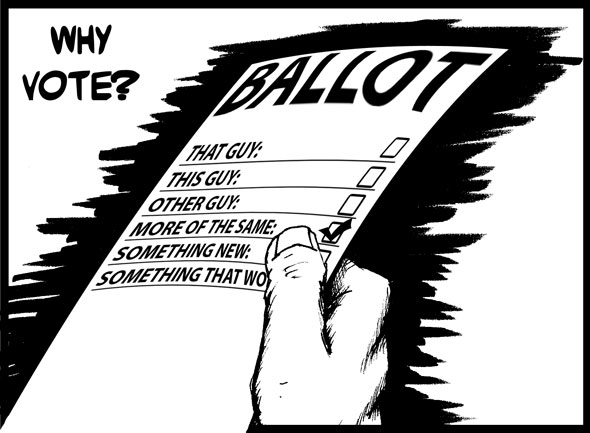
Optimistic observers assert that citizens in the United States don’t vote because they’re confident that their system functions well automatically, and therefore, they don’t need to go to the polls to defend it. Pessimists suggest the opposite: that they don’t vote because nothing would change if they did; therefore, they needn’t trouble themselves making a trip to the voting booth.
Although I consider myself an optimist, on this matter, I side with the pessimists. I believe that a minority of the country’s population feels that voting will accomplish any kind of change. In each election held in the United States, abstention wins the majority. It doesn’t matter if they’re local, county, state or federal. No matter which level or type of election is held in this country, the majority of citizens stay at home. Sometimes turnout is somewhat more or somewhat less, but in 90 percent of cases, abstention is the winner.
There was an election in Miami-Dade County a few days ago. It was a special election to elect a new mayor. The previous mayor had been recalled — also in a special election — a little more than a month ago. This mayoral ballot offered 11 candidates, and in order for any of them to be elected, one must receive more than 50 percent of votes cast.
From the beginning it was apparent that none of them would receive this percentage; therefore, we were sure that there would be a second round of voting to choose between the two with the most votes. And so it happens that within another month, there will be a third special election. If we keep in mind that each of these elections has cost $4 to $5 million, with the recall of the previous mayor and the election of his replacement, the county will spend between $12 and $15 million. This amount is low, considering that the county budget is $70 billion, more or less, but it is huge considering it is firing employees and raising taxes for lack of funds.
Firstly, the mayor didn’t need to be removed from his post. He could have been allowed to finish his term, given that he wasn’t accused of corruption or any criminal wrongdoing but of simply poor government management. Secondly, the county commission, before the mayoral recall, could have named anybody as a replacement in order to finish the year-and-a-half that remain in the term. The commission had the power to do it.
Now then, the election was held, and only 16 percent of voters took the trouble to vote. What happened? Some 84 percent of voters stayed home or went to the beach or didn’t know an election was taking place. Is this confidence in the system or indifference to the candidates? I think the latter predominated. The people were bored and tired of politicians who promise so much and then do nothing when elected.
Registered voters in Miami-Dade County numbered 1.2 million, and 193,303 voted; that is to say 15.9 percent of total voters. Let’s remember this election cost roughly $4.5 million — for each vote cast, the county spent about $23. At least as far as the cost, we can see the actual value of voting. This money came from taxpayers who pay enough taxes in this city — taxes which, when raised, cost the last mayor his job.
With the high expense of elections, with the indifference of the population toward them and with the fact that nothing changed in their taking place, eventually it might be better to appoint officials instead of electing them. In all, since they changed nothing and voters hardly participated, why did they take place? Perhaps it would be good to ask again here in Miami: Why have elections?
Lázaro Fariñas is a Cuban journalist based in Miami.
Although I consider myself an optimist, on this matter, I side with the pessimists. I believe that a minority of the country’s population feels that voting will accomplish any kind of change. In each election held in the United States, abstention wins the majority. It doesn’t matter if they’re local, county, state or federal. No matter which level or type of election is held in this country, the majority of citizens stay at home. Sometimes turnout is somewhat more or somewhat less, but in 90 percent of cases, abstention is the winner.
There was an election in Miami-Dade County a few days ago. It was a special election to elect a new mayor. The previous mayor had been recalled — also in a special election — a little more than a month ago. This mayoral ballot offered 11 candidates, and in order for any of them to be elected, one must receive more than 50 percent of votes cast.
From the beginning it was apparent that none of them would receive this percentage; therefore, we were sure that there would be a second round of voting to choose between the two with the most votes. And so it happens that within another month, there will be a third special election. If we keep in mind that each of these elections has cost $4 to $5 million, with the recall of the previous mayor and the election of his replacement, the county will spend between $12 and $15 million. This amount is low, considering that the county budget is $70 billion, more or less, but it is huge considering it is firing employees and raising taxes for lack of funds.
Firstly, the mayor didn’t need to be removed from his post. He could have been allowed to finish his term, given that he wasn’t accused of corruption or any criminal wrongdoing but of simply poor government management. Secondly, the county commission, before the mayoral recall, could have named anybody as a replacement in order to finish the year-and-a-half that remain in the term. The commission had the power to do it.
Now then, the election was held, and only 16 percent of voters took the trouble to vote. What happened? Some 84 percent of voters stayed home or went to the beach or didn’t know an election was taking place. Is this confidence in the system or indifference to the candidates? I think the latter predominated. The people were bored and tired of politicians who promise so much and then do nothing when elected.
Registered voters in Miami-Dade County numbered 1.2 million, and 193,303 voted; that is to say 15.9 percent of total voters. Let’s remember this election cost roughly $4.5 million — for each vote cast, the county spent about $23. At least as far as the cost, we can see the actual value of voting. This money came from taxpayers who pay enough taxes in this city — taxes which, when raised, cost the last mayor his job.
With the high expense of elections, with the indifference of the population toward them and with the fact that nothing changed in their taking place, eventually it might be better to appoint officials instead of electing them. In all, since they changed nothing and voters hardly participated, why did they take place? Perhaps it would be good to ask again here in Miami: Why have elections?
Lázaro Fariñas is a Cuban journalist based in Miami.
Previous article
