
US Espionage and Blatant Hypocrisy
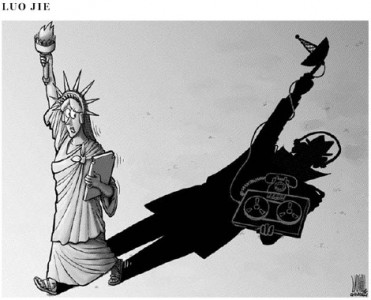
The government of France and its president, Francois Hollande, just lodged a formal protest with their friend and ally, the United States, because it was intercepting and recording millions of verbal and written messages communicated by French authorities, politicians, businesses and other groups of citizens and individuals. After the German secret service found out that Chancellor Merkel’s personal cellphone had been tapped, the German government and Chancellor Merkel personally sent similar messages to the U.S. The Argentine and Mexican governments, as well as Felipe Calderon, who had been spied upon continuously during his administration, also protested. Brazilian President Dilma Rousseff cancelled a trip she had planned to make to the U.S. and sent a formal complaint for such unacceptable meddling. The European Union and the Germany-France duo are responding collectively to the U.S. government. However, at the end of the day, the impact of this wave of indignation will not amount to much.
In effect, the U.S. appears unfazed when justifying its espionage program, insisting it is key to national security. The U.S. has not asked forgiveness; nor has it said it will stop committing such transgressions. Rather, the U.S. continues to extend with impunity its policing powers wherever possible. It is integrating its industrial espionage on foreign business competitors with its political espionage, using the information it gathers to blackmail corruptible public servants and military employees in its vassal states and their allies. These days, it is better to be a potential enemy of the U.S. (such as Russia and China) than a friend; it is less cynical and presumptuous for enemies than friends to deal with counterespionage.
The U.S. deploys groups of assassins to enter its vassal states and execute people like bin Laden who, after serving U.S. interests for a while, may turn into unfortunate witnesses and obstacles to its policies. Exercising what it dares to term extraterritoriality, the U.S. forcibly and illegally goes into sovereign nations such as Somalia, Yemen and Pakistan, kidnapping people who are then interrogated and held in floating prisons located in international waters. They are no longer held at Guantanamo (on Cuban soil) because it has become a politically untenable torture center.
The targets of espionage (who believe they are important people) are speaking up about the use of the same tactics that they used against semicolonial governments, knowing that phone tapping is part and parcel of Washington’s pretension to be judge, cop and executioner anywhere in the world, far exceeding Leonid Brezhnev’s theory of limited sovereignty.
To make matters worse, those who have a legitimate claim against massive espionage in their countries apply the same methods of control on their own societies without skipping a beat, as the French agency responsible for the so-called “security sector” (because they can’t say “citizen security”) has unabashedly admitted. In addition, they have known for years that they were being spied on by their allies. The German police immediately confirmed that Merkel’s communications had been tapped. Leaving Spain out of it for the moment, if the British and Italian governments are not screaming about these violations it’s only because they are too weak and servile to raise their voices against the master. But, they are fully aware of the fact that the Italian justice system condemned the CIA for illegally kidnapping a mullah who was residing in Italy and taking him to Cairo for interrogation. A cartoon in the Argentine daily Pagina/12 jokingly illustrates that this situation really isn’t funny by presenting a conversation between President Cristina Fernandez de Kirchner and one of her aides. The aide tells her that Obama has congratulated her on her recent recovery:
Fernandez de Kirchner: Tell Obama thanks very much and that I hope he is well.
Aide: Should I write to him?
Fernandez de Kirchner (in her office): It’s not necessary — he must be listening.
The individual liberties contained in national constitutions are continuously breached through the use of legal and clandestine force by police and nonpolice actors, and through the use of state apparatuses such as guns and gangster-style raids against citizens who protest and other adversaries of the political bourgeoisie. The dead and the disappeared, as well as the jailed or assassinated rural leaders in Mexico are all proof of these practices. The same practices occur in other countries where the correlation of social forces obliges capitalist governments to lean on violence and electoral fraud.
The worrisome thing about the U.S., which is just buying time by pushing forward with its enormous debt, is that it uses a war mentality when we are formally in a time of peace, albeit unstable. Equally worrisome is that U.S. allies are using the same logic. Meanwhile, with the shrinking social foundations in this time of peace, the crisis is pushing the conservative sectors in the U.S. and Europe toward xenophobia, racism and the extreme right, just like 30 years ago — fueling popular resistance that tends to become radicalized. The increase in class conflicts is another layer of a pre-world war situation.
For the time being, the political outcome of the interaction of these unstable and unsustainable forces remains unclear. At this point, no one has offered more than phony solutions — such as the search for democratic reforms — to a system that will not accept or tolerate them, or efforts to escape and disconnect from the world, burying one’s head in the sand. However, the time has come to examine what is happening, where we are now and where we are headed. That is the task.
In effect, the U.S. appears unfazed when justifying its espionage program, insisting it is key to national security. The U.S. has not asked forgiveness; nor has it said it will stop committing such transgressions. Rather, the U.S. continues to extend with impunity its policing powers wherever possible. It is integrating its industrial espionage on foreign business competitors with its political espionage, using the information it gathers to blackmail corruptible public servants and military employees in its vassal states and their allies. These days, it is better to be a potential enemy of the U.S. (such as Russia and China) than a friend; it is less cynical and presumptuous for enemies than friends to deal with counterespionage.
The U.S. deploys groups of assassins to enter its vassal states and execute people like bin Laden who, after serving U.S. interests for a while, may turn into unfortunate witnesses and obstacles to its policies. Exercising what it dares to term extraterritoriality, the U.S. forcibly and illegally goes into sovereign nations such as Somalia, Yemen and Pakistan, kidnapping people who are then interrogated and held in floating prisons located in international waters. They are no longer held at Guantanamo (on Cuban soil) because it has become a politically untenable torture center.
The targets of espionage (who believe they are important people) are speaking up about the use of the same tactics that they used against semicolonial governments, knowing that phone tapping is part and parcel of Washington’s pretension to be judge, cop and executioner anywhere in the world, far exceeding Leonid Brezhnev’s theory of limited sovereignty.
To make matters worse, those who have a legitimate claim against massive espionage in their countries apply the same methods of control on their own societies without skipping a beat, as the French agency responsible for the so-called “security sector” (because they can’t say “citizen security”) has unabashedly admitted. In addition, they have known for years that they were being spied on by their allies. The German police immediately confirmed that Merkel’s communications had been tapped. Leaving Spain out of it for the moment, if the British and Italian governments are not screaming about these violations it’s only because they are too weak and servile to raise their voices against the master. But, they are fully aware of the fact that the Italian justice system condemned the CIA for illegally kidnapping a mullah who was residing in Italy and taking him to Cairo for interrogation. A cartoon in the Argentine daily Pagina/12 jokingly illustrates that this situation really isn’t funny by presenting a conversation between President Cristina Fernandez de Kirchner and one of her aides. The aide tells her that Obama has congratulated her on her recent recovery:
Fernandez de Kirchner: Tell Obama thanks very much and that I hope he is well.
Aide: Should I write to him?
Fernandez de Kirchner (in her office): It’s not necessary — he must be listening.
The individual liberties contained in national constitutions are continuously breached through the use of legal and clandestine force by police and nonpolice actors, and through the use of state apparatuses such as guns and gangster-style raids against citizens who protest and other adversaries of the political bourgeoisie. The dead and the disappeared, as well as the jailed or assassinated rural leaders in Mexico are all proof of these practices. The same practices occur in other countries where the correlation of social forces obliges capitalist governments to lean on violence and electoral fraud.
The worrisome thing about the U.S., which is just buying time by pushing forward with its enormous debt, is that it uses a war mentality when we are formally in a time of peace, albeit unstable. Equally worrisome is that U.S. allies are using the same logic. Meanwhile, with the shrinking social foundations in this time of peace, the crisis is pushing the conservative sectors in the U.S. and Europe toward xenophobia, racism and the extreme right, just like 30 years ago — fueling popular resistance that tends to become radicalized. The increase in class conflicts is another layer of a pre-world war situation.
For the time being, the political outcome of the interaction of these unstable and unsustainable forces remains unclear. At this point, no one has offered more than phony solutions — such as the search for democratic reforms — to a system that will not accept or tolerate them, or efforts to escape and disconnect from the world, burying one’s head in the sand. However, the time has come to examine what is happening, where we are now and where we are headed. That is the task.