
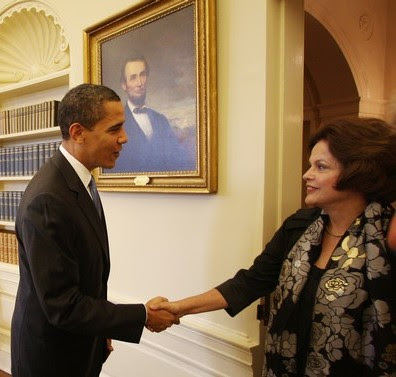
Dilma and Barack: An Irresistible Pair
In June 2003, Brazil’s new president traveled to Washington to meet George W. Bush. The day before that meeting, I published an article in the Financial Times where I urged Bush to be as daring with Brazil as he was with Iraq. I only asked, in Brazil’s case, that instead of looking for a regime change he would do everything possible to prop up Luiz Inácio Lula da Silva’s government. I proposed that he make an offer that da Silva could not refuse — a broad and generous trade agreement and solid backing for the social programs that the Brazilian had promised during his campaign — and that he would clarify with international financial markets (which during that time still viewed Lula with suspicion) that the White House did believe in the ex-syndicate leader and that it would give him its unrestricted support. That pact between those two continental giants, I wrote, would then transform not only Brazil, but the entire region in a very profound way. If both countries promised each other to reduce their international trade restrictions and defend democracy on the continent together, and also invite their allies to join that alliance, they would trigger a positive economic and political revolution in the hemisphere. For the rest of the countries, being excluded from an agreement of this magnitude would impose prohibitive costs.
That first meeting between Lula and Bush was very successful, and the conservative American and Labor Party Brazilian surprised the world with their very cordial initial relations. But nothing else happened. Nevertheless, seven years later, my idea continues to be valid.
A solid alliance between Brazil and the United States can be one of the most important geopolitical innovations of our time — and maybe the most viable. It’s not about the fact that Brazilian soldiers are going to die in arbitrary American wars, or that Brazil would abide by Washington’s dictations. It’s about arriving at a series of agreements — very plausible ones — about topics essential to both countries and to the rest of the world: business relations about climate change, about financial reforms, international relations and nuclear proliferation; or the way the world will handle the inevitable displacements produced by the growing economic and political power of China, India and of course Brazil.
It’s obvious that both countries should make concessions, and for both the northern superpower and the southern giant, it will not be easy to accept some of the other’s conditions. But this is what it’s about. It’s about understanding that accepting these compromises is a price worth paying.
My proposition, then, is that Dilma Rousseff, the next Brazilian president, makes Barack Obama an offer so attractive that he can’t allow himself the luxury of rejecting it. For many other reasons, Obama is going to be much more receptive to this opportunity to make history than his predecessor. For Brazilians, this supposes a difficult change: to stop believing that what is convenient for the United States is bad for Brazil. Sometimes it’s that way, and the interests of one clash with the interests of the other. But in many other cases, that’s not so.
I know well the list of objections and obstacles to this proposal. And I know that it’s still naïve. But it’s not a bad exercise that the next Brazilian president thinks courageously about how to revolutionize the relationship between the United States and Brazil. The potential well being and progress that would be unleashed if this naïveté became reality is too big for her to not even imagine or explore it. Skepticism sometimes can be more burdensome and blinding than naïveté.
That first meeting between Lula and Bush was very successful, and the conservative American and Labor Party Brazilian surprised the world with their very cordial initial relations. But nothing else happened. Nevertheless, seven years later, my idea continues to be valid.
A solid alliance between Brazil and the United States can be one of the most important geopolitical innovations of our time — and maybe the most viable. It’s not about the fact that Brazilian soldiers are going to die in arbitrary American wars, or that Brazil would abide by Washington’s dictations. It’s about arriving at a series of agreements — very plausible ones — about topics essential to both countries and to the rest of the world: business relations about climate change, about financial reforms, international relations and nuclear proliferation; or the way the world will handle the inevitable displacements produced by the growing economic and political power of China, India and of course Brazil.
It’s obvious that both countries should make concessions, and for both the northern superpower and the southern giant, it will not be easy to accept some of the other’s conditions. But this is what it’s about. It’s about understanding that accepting these compromises is a price worth paying.
My proposition, then, is that Dilma Rousseff, the next Brazilian president, makes Barack Obama an offer so attractive that he can’t allow himself the luxury of rejecting it. For many other reasons, Obama is going to be much more receptive to this opportunity to make history than his predecessor. For Brazilians, this supposes a difficult change: to stop believing that what is convenient for the United States is bad for Brazil. Sometimes it’s that way, and the interests of one clash with the interests of the other. But in many other cases, that’s not so.
I know well the list of objections and obstacles to this proposal. And I know that it’s still naïve. But it’s not a bad exercise that the next Brazilian president thinks courageously about how to revolutionize the relationship between the United States and Brazil. The potential well being and progress that would be unleashed if this naïveté became reality is too big for her to not even imagine or explore it. Skepticism sometimes can be more burdensome and blinding than naïveté.
Next article
