

Military Strike on Venezuela: US Hegemonic Actions Spark Global Wave of Protests
Published in Guangming Daily News
(China) on 5 January 2026
by Yang Yifu and Cao Yuanlong (link to
original)
With 2026 barely in its infancy, the United States has shocked the world with a military operation in serious violation of international law. In the early hours of Jan. 3 local time, multiple explosions suddenly rang out in the skies above the Venezuelan capital of Caracas, followed by air-raid sirens, plunging the city into chaos. After carrying out a large-scale strike on Venezuela, the United States forcibly detained President Nicolás Maduro and his wife, and transferred them out of the country. President Donald Trump subsequently declared that the United States would temporarily “run” Venezuela and develop the country’s abundant oil resources.
The United States’ despotic actions have sparked worldwide condemnation, with Latin American countries in particular asking angrily: Who will be next?
Long-Coveted Venezuelan Oill
According to U.S. Attorney General Pam Bondi, Maduro and his wife have been indicted in the U.S. District Court for the Southern District of New York. She stated that Maduro is being charged with “Narco-Terrorism Conspiracy, Cocaine Importation Conspiracy, Possession of Machineguns and Destructive Devices, and Conspiracy to Possess Machineguns and Destructive Devices against the United States.”
For many years, counternarcotics has been one of the main pretexts cited by the U.S. government in its efforts to overthrow the Venezuelan regime. In 2020, the final year of Trump’s first presidential term, Maduro had already been indicted in the Southern District of New York federal court; at the time, U.S. prosecutors accused him of helping lead the Cartel of the Suns, a drug-trafficking network comprised of senior Venezuelan government and military officials, and of cooperating with the Revolutionary Armed Forces of Colombia to ship several tons of cocaine to the United States. Since then, Washington has repeatedly increased the bounty on Maduro’s head, raising it to $50 million last August. However, there is currently no evidence indicating that Maduro directly commanded drug-smuggling operations.
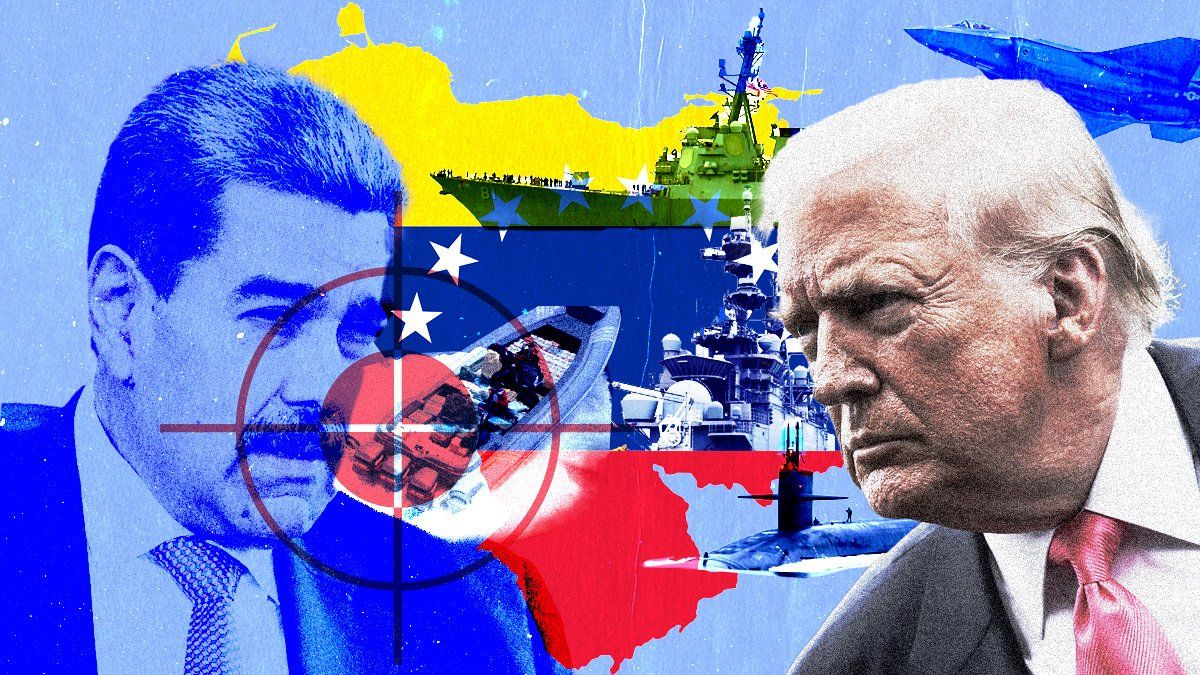
Since August, the U.S. government had been intensifying pressure on Maduro, with Trump ordering a large-scale troop buildup along Venezuela’s northern coast and launching a series of air strikes against what are known as “drug boats,” operations resulting in at least 110 deaths to date. In the face of American pressure, Maduro had recently shown a willingness to negotiate.
Days before the attacks, in an interview with a Spanish journalist, Maduro had said, “If they want to speak seriously about an agreement to battle drug trafficking, we are ready. ... If they want Venezuela’s oil, Venezuela is ready to accept U.S. investments like those of Chevron, when, where and how they want to make them.”
But this conciliatory attitude clearly failed to satisfy Trump, as the United States’ aim was to overthrow the Maduro regime and take direct control of the situation in Venezuela, thus ensuring “America First.” According to U.S. Defense Secretary Pete Hegseth, Trump’s plan involves “protecting American interests [in Venezuela] and ensuring they’re advanced,” and that regarding the future of Venezuela, “we set the terms.” Trump has stated that the United States will temporarily "run" Venezuela, and that “American dominance in the Western Hemisphere will never be questioned again.”
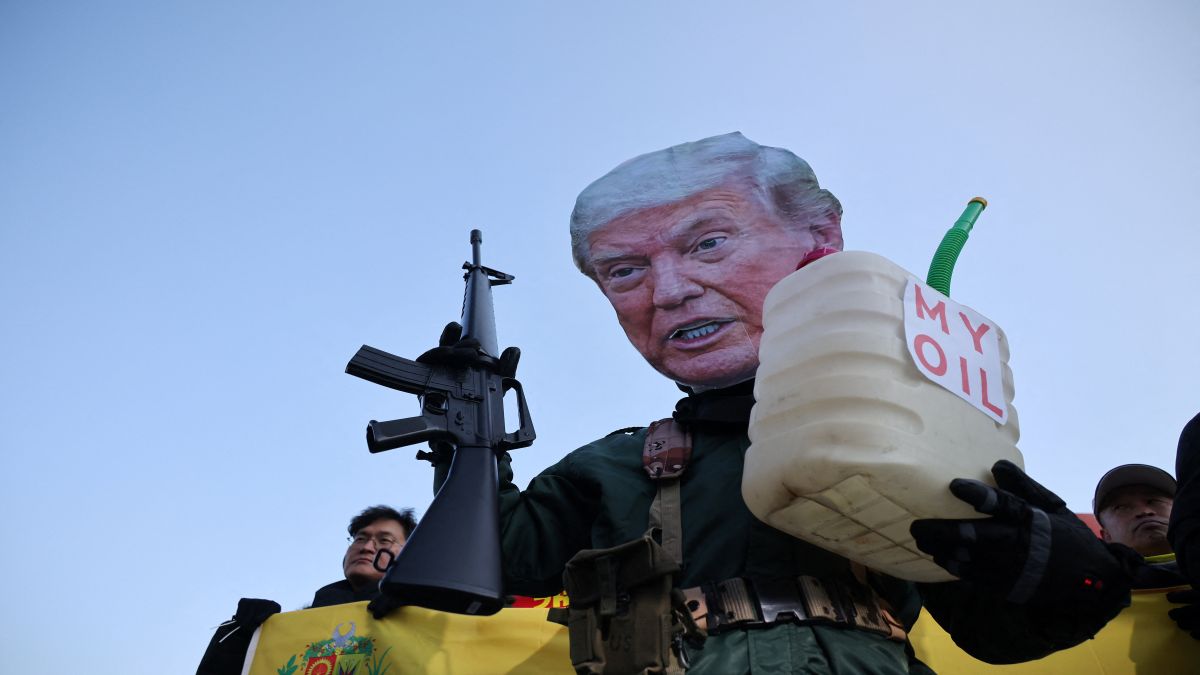
Andrew Lipow, president of Lipow Oil Associates, believes that Trump’s comments indicate that American military action in Venezuela is “entirely about oil.”* According to sources cited by Politico, U.S. government officials informed oil company executives in recent weeks that if they wished to receive compensation for drilling platforms, pipelines and other seized assets, they must be prepared to return to Venezuela immediately and invest massively in reviving the country’s beleaguered oil industry. However, industry insiders say they are concerned about the difficulty of rebuilding the deteriorated oil fields, especially given the uncertainty surrounding who will lead the country in the near future.
A BBC commentary notes that Trump’s pledge to “fix [Venezuela’s] broken infrastructure” would require the United States to invest an enormous amount of time and energy. For someone who has previously criticized U.S.-led regime change efforts elsewhere in the world, this represents a dramatic shift. Brett Bruen, a foreign policy adviser during the Obama administration, has stated that the United States may now be forced to oversee a complex transition process. “The U.S. will get tangled up in Venezuela but will also have new problems to contend with related to its neighbors,” he noted.
According to Professor Cui Shoujun of the School of International Studies at China’s Renmin University, there is no doubt that the Trump administration covets Venezuela’s oil resources, as the country holds the world’s largest proven oil reserves. Trump has publicly stated that the United States will run Venezuela until a “safe, proper and judicious transition” can be achieved, while also hinting that major American oil companies will enter the country. This, Cui argues, shows that Washington is attempting to open up Venezuela’s oil market through regime change and weaken the country’s control over its oil sovereignty. In addition, Trump is seeking to extract maximum political benefit at minimal cost, using the move to bolster his domestic political image, appeal to right-wing voters, and add to his political capital ahead of the 2026 midterm elections.
'There Is No Reason for Us To Be at War with Venezuela.'
The U.S. government stressed that the military operation was initiated at the request of the Department of Justice in order to protect personnel executing the arrest warrants. In subsequent statements, U.S. officials insisted that Maduro “lacks governing legitimacy,” a claim intended to circumvent both domestic law regarding the “right to declare war” or unauthorized uses of force, as well as international law protections granting a sitting head of state personal inviolability and immunity from criminal jurisdiction. The move sparked strong opposition within American society and among Democratic Party members of Congress, many of whom stated that they had been caught completely unawares. Protests erupted across multiple parts of the United States against the military action in Venezuela.
“We have no vital national interests in Venezuela to justify war,” Hawaii Democratic Sen. Brian Schatz posted on his X/Twitter account. “We should have learned not to stumble into another stupid adventure by now.” And Arizona Democratic Sen. Ruben Gallego has stated, “This war is illegal, it’s embarrassing that we went from the world cop to the world bully in less than one year. There is no reason for us to be at war with Venezuela.” Left-wing independent Sen. Bernie Sanders has condemned the action as a shameless flouting of international law, and as giving the green light to any country in the world that might wish to attack another state, plunder its resources, or change its government.
The Washington Post reported that the U.S. military operation fulfilled Trump’s long-held desire to overthrow the Venezuelan regime, but that it was carried out without congressional authorization, clearly violating both domestic and international law and leaving Venezuela’s future fraught with uncertainty.
“Trump is no longer bending the rules — he is demolishing them,” read a commentary published in the U.K.’s The Guardian newspaper. “The overnight strikes on Venezuela, the abduction of its leader, Nicolás Maduro, and his wife, and Donald Trump’s declaration that the U.S. would ‘run’ the country and sell its oil, have driven another truck through international law and global norms.” The attack on Venezuela, the article adds, shows that “the allure of foreign lands, oil and minerals [now glimmers] brighter than the Nobel Peace Prize.”
The Zone of Peace Is under 'Brutal Assault.'
On Jan. 3, Venezuela’s Supreme Tribunal of Justice (its constitutional court), issued a ruling ordering Vice President Delcy Rodríguez to assume and exercise all powers, duties and authorities inherent to the office of the president of Venezuela as “acting president.” Trump responded that Rodríguez would help the United States govern Venezuela, a claim she quickly denied. Trump also indicated that, if necessary, the United States was prepared to launch a second round of attacks, leaving Venezuela’s future political situation shrouded in uncertainty.
The United States’ hegemonic use of force against a sovereign nation and its sitting president has sparked global outrage, with Latin American countries in particular widely condemning the attack. Speaking at a press conference in Santiago on Jan. 3, Chilean President Gabriel Boric denounced the military action, stating, “Today, it is Venezuela; tomorrow it could be any other country.” Cuban President Miguel Díaz-Canel condemned the United States’ “criminal attack,” calling it a “brutal assault” on a “Zone of Peace.” Brazilian President Luiz Inácio Lula da Silva declared that the United States’ actions “[crossed] an unacceptable line” and constituted a “flagrant violation” of Venezuelan sovereignty, and he called for a “vigorous response” from the international community. And, in a statement, the Mexican Foreign Ministry also characterized the attacks as “[putting] regional stability seriously at risk.”
In response to the United States’ military action, an emergency meeting of the Caribbean Community heads of government was held on Jan. 3. The organization stated that it is closely monitoring the situation, noting that developments had raised serious regional concerns and could impact neighboring countries.
The new U.S. National Security Strategy report released in December 2025 explicitly states that the United States’ strategic focus will shift back to the Western Hemisphere, but in the wake of the U.S. raid on Venezuela, media commentary has noted that the Trump administration appears to have lowered its reservations about using force, prompting concern within the international community. At a Jan. 3 press conference, Trump also added Cuba to his list of target countries, calling it “very similar” to Venezuela, and U.S. Secretary of State Marco Rubio added that Havana should feel “concerned” after the incident there. More dramatically still, shortly after the United States forcibly detained Maduro, the wife of White House senior adviser Stephen Miller posted an image of Greenland on social media, overlaid with the American flag and the caption, “Soon.”
Professor Cui Shoujun [of the School of International Relations at Renmin University of China] believes that, in sending troops into Venezuelan territory without U.N. authorization and taking a sitting head of state into custody, the United States has seriously violated Article 2 of the U.N. Charter, which prohibits the use of force. The United States’ actions also trample over the customary international law granting heads of state absolute immunity, amounting to what Cui describes as an act of international kidnapping. The incident has set a dangerous precedent: Powerful nations can bypass the mechanism of international judicial cooperation, directly overthrow foreign regimes, and prosecute their leaders. Such actions will weaken the authority of the U.N. Security Council, Cui warns, leading the international order to slide toward the “law of the jungle.”
*Editor's note: Although accurately translated, this quoted passage could not be independently verified.
The United States’ despotic actions have sparked worldwide condemnation, with Latin American countries in particular asking angrily: Who will be next?
Long-Coveted Venezuelan Oill
According to U.S. Attorney General Pam Bondi, Maduro and his wife have been indicted in the U.S. District Court for the Southern District of New York. She stated that Maduro is being charged with “Narco-Terrorism Conspiracy, Cocaine Importation Conspiracy, Possession of Machineguns and Destructive Devices, and Conspiracy to Possess Machineguns and Destructive Devices against the United States.”
For many years, counternarcotics has been one of the main pretexts cited by the U.S. government in its efforts to overthrow the Venezuelan regime. In 2020, the final year of Trump’s first presidential term, Maduro had already been indicted in the Southern District of New York federal court; at the time, U.S. prosecutors accused him of helping lead the Cartel of the Suns, a drug-trafficking network comprised of senior Venezuelan government and military officials, and of cooperating with the Revolutionary Armed Forces of Colombia to ship several tons of cocaine to the United States. Since then, Washington has repeatedly increased the bounty on Maduro’s head, raising it to $50 million last August. However, there is currently no evidence indicating that Maduro directly commanded drug-smuggling operations.
Since August, the U.S. government had been intensifying pressure on Maduro, with Trump ordering a large-scale troop buildup along Venezuela’s northern coast and launching a series of air strikes against what are known as “drug boats,” operations resulting in at least 110 deaths to date. In the face of American pressure, Maduro had recently shown a willingness to negotiate.
Days before the attacks, in an interview with a Spanish journalist, Maduro had said, “If they want to speak seriously about an agreement to battle drug trafficking, we are ready. ... If they want Venezuela’s oil, Venezuela is ready to accept U.S. investments like those of Chevron, when, where and how they want to make them.”
But this conciliatory attitude clearly failed to satisfy Trump, as the United States’ aim was to overthrow the Maduro regime and take direct control of the situation in Venezuela, thus ensuring “America First.” According to U.S. Defense Secretary Pete Hegseth, Trump’s plan involves “protecting American interests [in Venezuela] and ensuring they’re advanced,” and that regarding the future of Venezuela, “we set the terms.” Trump has stated that the United States will temporarily "run" Venezuela, and that “American dominance in the Western Hemisphere will never be questioned again.”
Andrew Lipow, president of Lipow Oil Associates, believes that Trump’s comments indicate that American military action in Venezuela is “entirely about oil.”* According to sources cited by Politico, U.S. government officials informed oil company executives in recent weeks that if they wished to receive compensation for drilling platforms, pipelines and other seized assets, they must be prepared to return to Venezuela immediately and invest massively in reviving the country’s beleaguered oil industry. However, industry insiders say they are concerned about the difficulty of rebuilding the deteriorated oil fields, especially given the uncertainty surrounding who will lead the country in the near future.
A BBC commentary notes that Trump’s pledge to “fix [Venezuela’s] broken infrastructure” would require the United States to invest an enormous amount of time and energy. For someone who has previously criticized U.S.-led regime change efforts elsewhere in the world, this represents a dramatic shift. Brett Bruen, a foreign policy adviser during the Obama administration, has stated that the United States may now be forced to oversee a complex transition process. “The U.S. will get tangled up in Venezuela but will also have new problems to contend with related to its neighbors,” he noted.
According to Professor Cui Shoujun of the School of International Studies at China’s Renmin University, there is no doubt that the Trump administration covets Venezuela’s oil resources, as the country holds the world’s largest proven oil reserves. Trump has publicly stated that the United States will run Venezuela until a “safe, proper and judicious transition” can be achieved, while also hinting that major American oil companies will enter the country. This, Cui argues, shows that Washington is attempting to open up Venezuela’s oil market through regime change and weaken the country’s control over its oil sovereignty. In addition, Trump is seeking to extract maximum political benefit at minimal cost, using the move to bolster his domestic political image, appeal to right-wing voters, and add to his political capital ahead of the 2026 midterm elections.
'There Is No Reason for Us To Be at War with Venezuela.'
The U.S. government stressed that the military operation was initiated at the request of the Department of Justice in order to protect personnel executing the arrest warrants. In subsequent statements, U.S. officials insisted that Maduro “lacks governing legitimacy,” a claim intended to circumvent both domestic law regarding the “right to declare war” or unauthorized uses of force, as well as international law protections granting a sitting head of state personal inviolability and immunity from criminal jurisdiction. The move sparked strong opposition within American society and among Democratic Party members of Congress, many of whom stated that they had been caught completely unawares. Protests erupted across multiple parts of the United States against the military action in Venezuela.
“We have no vital national interests in Venezuela to justify war,” Hawaii Democratic Sen. Brian Schatz posted on his X/Twitter account. “We should have learned not to stumble into another stupid adventure by now.” And Arizona Democratic Sen. Ruben Gallego has stated, “This war is illegal, it’s embarrassing that we went from the world cop to the world bully in less than one year. There is no reason for us to be at war with Venezuela.” Left-wing independent Sen. Bernie Sanders has condemned the action as a shameless flouting of international law, and as giving the green light to any country in the world that might wish to attack another state, plunder its resources, or change its government.
The Washington Post reported that the U.S. military operation fulfilled Trump’s long-held desire to overthrow the Venezuelan regime, but that it was carried out without congressional authorization, clearly violating both domestic and international law and leaving Venezuela’s future fraught with uncertainty.
“Trump is no longer bending the rules — he is demolishing them,” read a commentary published in the U.K.’s The Guardian newspaper. “The overnight strikes on Venezuela, the abduction of its leader, Nicolás Maduro, and his wife, and Donald Trump’s declaration that the U.S. would ‘run’ the country and sell its oil, have driven another truck through international law and global norms.” The attack on Venezuela, the article adds, shows that “the allure of foreign lands, oil and minerals [now glimmers] brighter than the Nobel Peace Prize.”
The Zone of Peace Is under 'Brutal Assault.'
On Jan. 3, Venezuela’s Supreme Tribunal of Justice (its constitutional court), issued a ruling ordering Vice President Delcy Rodríguez to assume and exercise all powers, duties and authorities inherent to the office of the president of Venezuela as “acting president.” Trump responded that Rodríguez would help the United States govern Venezuela, a claim she quickly denied. Trump also indicated that, if necessary, the United States was prepared to launch a second round of attacks, leaving Venezuela’s future political situation shrouded in uncertainty.
The United States’ hegemonic use of force against a sovereign nation and its sitting president has sparked global outrage, with Latin American countries in particular widely condemning the attack. Speaking at a press conference in Santiago on Jan. 3, Chilean President Gabriel Boric denounced the military action, stating, “Today, it is Venezuela; tomorrow it could be any other country.” Cuban President Miguel Díaz-Canel condemned the United States’ “criminal attack,” calling it a “brutal assault” on a “Zone of Peace.” Brazilian President Luiz Inácio Lula da Silva declared that the United States’ actions “[crossed] an unacceptable line” and constituted a “flagrant violation” of Venezuelan sovereignty, and he called for a “vigorous response” from the international community. And, in a statement, the Mexican Foreign Ministry also characterized the attacks as “[putting] regional stability seriously at risk.”
In response to the United States’ military action, an emergency meeting of the Caribbean Community heads of government was held on Jan. 3. The organization stated that it is closely monitoring the situation, noting that developments had raised serious regional concerns and could impact neighboring countries.
The new U.S. National Security Strategy report released in December 2025 explicitly states that the United States’ strategic focus will shift back to the Western Hemisphere, but in the wake of the U.S. raid on Venezuela, media commentary has noted that the Trump administration appears to have lowered its reservations about using force, prompting concern within the international community. At a Jan. 3 press conference, Trump also added Cuba to his list of target countries, calling it “very similar” to Venezuela, and U.S. Secretary of State Marco Rubio added that Havana should feel “concerned” after the incident there. More dramatically still, shortly after the United States forcibly detained Maduro, the wife of White House senior adviser Stephen Miller posted an image of Greenland on social media, overlaid with the American flag and the caption, “Soon.”
Professor Cui Shoujun [of the School of International Relations at Renmin University of China] believes that, in sending troops into Venezuelan territory without U.N. authorization and taking a sitting head of state into custody, the United States has seriously violated Article 2 of the U.N. Charter, which prohibits the use of force. The United States’ actions also trample over the customary international law granting heads of state absolute immunity, amounting to what Cui describes as an act of international kidnapping. The incident has set a dangerous precedent: Powerful nations can bypass the mechanism of international judicial cooperation, directly overthrow foreign regimes, and prosecute their leaders. Such actions will weaken the authority of the U.N. Security Council, Cui warns, leading the international order to slide toward the “law of the jungle.”
*Editor's note: Although accurately translated, this quoted passage could not be independently verified.
Previous article
Next article
 "Panama and Venezuela, 36 Years Apart: How Bush and Trump Used Law to Break Law")