
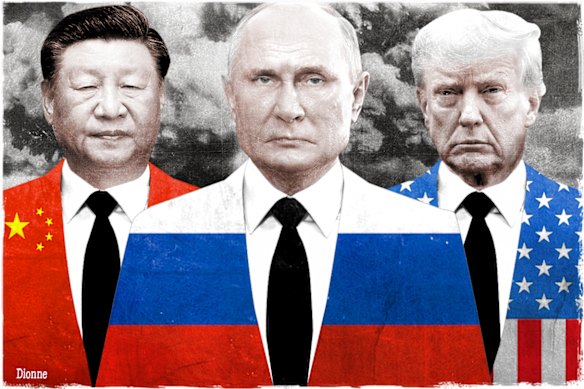
The Trump-Xi-Putin Summit Has Exposed the Weakness of the Great Powers
The symbolic meeting of the three achieved little, and couldn't have done much anyway. In a world of growing disorder, their power is limited.
The 90 minutes that Xi Jinping, Donald Trump and Vladimir Putin spent together in Shenzhen in southern China on Thursday didn't change the world. As you can see from the statements, the talks between the presidents of China, the U.S. and Russia brought no concrete results. It was pure political theater, a symbolic performance of which the significance is currently unknown.
All three leaders can feel like winners afterward: Putin, because he stood on equal footing with the real superpowers and shattered the image of his international isolation; Xi, because, as a gracious host, he could emphasize China's leading role in the world; and Trump, because he got to spend time with the autocrats he adores and find a distraction from his domestic political woes following the lost congressional election.
Trump can fly home feeling satisfied, but the U.S. emerges from the first ever tripartite summit in a weakened state. The president's flattery of the aggressor from Moscow and the tyrant from Beijing undermines the moral authority that the democratic U.S. was once able to project. As for Putin, Trump's expression of friendship strengthens his hope that the U.S. will finally abandon Ukraine militarily by the end of Trump's term in office, which has not happened so far. This undermines the chances of an end to the war, which Trump has been promising for two years.
Help Our Farmers
In relation to China, Trump's request to Xi stood out: "I'll be asking you to do some more for our farmers because China has an insatiable appetite, I can tell you that we fill that appetite. As long as you and I are in charge of things, we'll never have a problem." With this, he signaled that China has the upper hand in the trade war that he, himself, declared. They can confidently enter negotiations regarding a renewal of the moratorium on mutual tariffs, which expires in January 2027.
The final communiqué itself was vague, even by summit standards. Trump's intention to discuss nuclear disarmament resulted in a meaningless declaration, as China intends to continue expanding its arsenal. Reform of the United Nations remains just as unrealistic as ever, because the veto powers do not want it. Also, the criticism of the International Criminal Court will have little impact because none of the three countries has ever joined the court.
Pomp Instead of Strength
Even if the three had tried to divide the world between them, they would hardly have succeeded. The pomp of the spectacle masks the weaknesses of the three superpowers. Trump and Putin are both mired in wars with middle powers that they cannot win. Trump's domestic power has been curtailed since the midterms, and Russia is paying the economic and human cost for its aggression against Ukraine, which will continue to weigh on the country for many years to come. China, for its part, is confronting economic and demographic problems for which Xi's autocratic regime neither seeks nor finds solutions. Its influence, particularly in its own region, is weaker than the conference of the 21 Pacific Rim nations would have people believe.
The main problem in the world today is not the dominance of the powerful, but the absence of one or more responsible power capable of maintaining order. The trilateral summit, with much pomp and little impact, has demonstrated this once again.
Previous article