
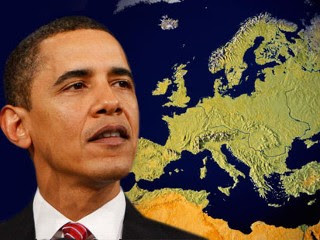
Romney, Obama and the Future of Europe
Don’t listen to the ideologues: the candidates in the U.S. election campaign are more similar than they would like to believe. Practical constraints are stronger than “Yes We Can” rhetoric and tea party radicalism.
After the tragicomedy of the Republican primary, the real campaign for the most powerful position in the world has finally begun: Mitt Romney versus Barack Obama. The ideologues of both parties will present the fight as a showdown between a right-wing radical reactionary, at odds with the populous and a puppet to big money on one side, and a left-wing radical cultural revolutionary, opposed to the church and a puppet to Islam on the other side.
The reality is more boring: a conservative candidate, pragmatic to the point of appearing unprincipled, has entered the race for the Republicans; for the Democrats, a left-liberal beacon of hope, who has been set back several steps by reality. Romney is a wooden orator, but a competent manager; Obama a gifted rhetorician who lacks an agenda and who has, thus far, seen little good fortune. If Obama reminds us less of the great reformer Lyndon B. Johnson than of John F. Kennedy, reputed to be more form than substance, so Romney is more of a George Bush Sr. than a Ronald Reagan.
The Tea Party Will Become More Docile
The first lesson from Romney’s victory in the primary reads: the tea party’s revolution against the establishment is over. Bearing in mind that others who at times looked like the favorite included an entrepreneur whose program consisted solely of a flat tax of nine percent, and a fundamentalist Catholic who questioned the separation of church and state, Romney, despite his rightward turn on health care reform and tax cuts, seems to signal the return to “business as usual.”
Since the victor will have – if trends continue – at best a slim majority win, and moreover will have to deal with a Congress that is politically paralyzed by the unwillingness of either party to compromise, only a centrist can hope to accomplish anything. Even Barack Obama, who as a candidate was able to use leftist rhetoric, as President has so far pursued a centrist policy. “Yes we can!” and “Change we can believe in” has become a campaign of the lesser evil, similar to Gerhard Schröder’s fight against Edmund Stoiber in 2002, after the disappearance of the euphoria over the red-green renewal. And yet, let’s not forget: After Schröder’s victory came Agenda 2010 [a series of social and labor reforms implemented by the German coalition government].
Spending and Saving Simultaneously
The U.S. needs something similar to Agenda 2010. Four years after the crash, the economy is still not doing well. The growth rates are unsatisfactory, the National Debt higher than the combined debts of the Euro-zone. Both Obama and Romney advocate varieties of Keynesianism: Romney supports encouraging the economy through tax cuts, while Obama supports investments.
In view of the debt, both will be needed to square the circle: save money strategically, in order to prepare the country for the future and spend money tactically, so that the nation doesn’t slide back into recession. Regardless of who lives in the White House in 2013, he will have to encroach upon two sacred cows: Medicare, the complimentary and absurdly expensive health care program for the elderly, and the ardently beloved armed forces. Romney promises to put four percent of the Gross National Product into the armed forces annually, but that is hardly realistic. After the completion of the imperial adventures in Iraq and Afghanistan, the military will provide, in the words of Dwight Eisenhower, “more bang for the buck.”
What Does This Mean for Europe?
What does this mean for Europe? George W. Bush, elected on a platform of a humble foreign policy, announced after 9/11 the agenda of using America’s position as the sole superpower to free the world through democracy and continental Europeans were frightened. Many longed for a multi-polar world, in which the European Union would have greater weight.
Under Obama, the U.S. has been much more cautious – so cautious, that the president had to put up with European criticism over his delayed support of the Iranian protest movement, the “Arab Spring” and the Libyan rebels. From North Korea to Iran via Syria and the Sudan, China and Russia have thwarted U.S. lines without having to pay a price.
Obama himself has declared his disinterest in the Middle East, which also has to do with the fact that America, unlike Europe, no longer needs the oil from that region. Admittedly, the EU has used the weakness of the leading power in order to say goodbye, through the Euro-crisis and other disputes, to international insignificance.
Europe is Angry with Obama
Moreover, an instinctive anti-Americanism continues to exist in Europe, which takes issue no longer with neo-liberals and neo-cons, but rather with neo-Keynesianism. With this comes a devotion – however contentious – to a Thatcheresque austerity-regime that even hurts American exports and moreover hinders Obama’s re-election. Even in 2012, the adage applies: “It’s the economy, stupid!”
In European eyes, Obama has mutated from a shining beacon to a tiny light. And it turns out there’s only one thing worse than aggressive leadership by the U.S: the lack of such leadership. Could Romney succeed where Obama has failed? Could he instill new confidence in America and increase its importance in the world, as Reagan did, after what Jimmy Carter referred to as “malaise”? Could Obama achieve this in a second term?
There’s reason to doubt both. Whoever leads America for the next four years will have to try, above all, to put America’s economy back on its feet, to reform the social system and to fill in domestic political trenches. In foreign policy, the relationship to the second-most powerful country on Earth – China – remains the greatest challenge. The good news for Europeans is also the bad: It won’t make any great difference who wins the 2012 election. We’re more or less home alone and we need not only to put this house in order, but also to tend to the neighborhood more than before.
After the tragicomedy of the Republican primary, the real campaign for the most powerful position in the world has finally begun: Mitt Romney versus Barack Obama. The ideologues of both parties will present the fight as a showdown between a right-wing radical reactionary, at odds with the populous and a puppet to big money on one side, and a left-wing radical cultural revolutionary, opposed to the church and a puppet to Islam on the other side.
The reality is more boring: a conservative candidate, pragmatic to the point of appearing unprincipled, has entered the race for the Republicans; for the Democrats, a left-liberal beacon of hope, who has been set back several steps by reality. Romney is a wooden orator, but a competent manager; Obama a gifted rhetorician who lacks an agenda and who has, thus far, seen little good fortune. If Obama reminds us less of the great reformer Lyndon B. Johnson than of John F. Kennedy, reputed to be more form than substance, so Romney is more of a George Bush Sr. than a Ronald Reagan.
The Tea Party Will Become More Docile
The first lesson from Romney’s victory in the primary reads: the tea party’s revolution against the establishment is over. Bearing in mind that others who at times looked like the favorite included an entrepreneur whose program consisted solely of a flat tax of nine percent, and a fundamentalist Catholic who questioned the separation of church and state, Romney, despite his rightward turn on health care reform and tax cuts, seems to signal the return to “business as usual.”
Since the victor will have – if trends continue – at best a slim majority win, and moreover will have to deal with a Congress that is politically paralyzed by the unwillingness of either party to compromise, only a centrist can hope to accomplish anything. Even Barack Obama, who as a candidate was able to use leftist rhetoric, as President has so far pursued a centrist policy. “Yes we can!” and “Change we can believe in” has become a campaign of the lesser evil, similar to Gerhard Schröder’s fight against Edmund Stoiber in 2002, after the disappearance of the euphoria over the red-green renewal. And yet, let’s not forget: After Schröder’s victory came Agenda 2010 [a series of social and labor reforms implemented by the German coalition government].
Spending and Saving Simultaneously
The U.S. needs something similar to Agenda 2010. Four years after the crash, the economy is still not doing well. The growth rates are unsatisfactory, the National Debt higher than the combined debts of the Euro-zone. Both Obama and Romney advocate varieties of Keynesianism: Romney supports encouraging the economy through tax cuts, while Obama supports investments.
In view of the debt, both will be needed to square the circle: save money strategically, in order to prepare the country for the future and spend money tactically, so that the nation doesn’t slide back into recession. Regardless of who lives in the White House in 2013, he will have to encroach upon two sacred cows: Medicare, the complimentary and absurdly expensive health care program for the elderly, and the ardently beloved armed forces. Romney promises to put four percent of the Gross National Product into the armed forces annually, but that is hardly realistic. After the completion of the imperial adventures in Iraq and Afghanistan, the military will provide, in the words of Dwight Eisenhower, “more bang for the buck.”
What Does This Mean for Europe?
What does this mean for Europe? George W. Bush, elected on a platform of a humble foreign policy, announced after 9/11 the agenda of using America’s position as the sole superpower to free the world through democracy and continental Europeans were frightened. Many longed for a multi-polar world, in which the European Union would have greater weight.
Under Obama, the U.S. has been much more cautious – so cautious, that the president had to put up with European criticism over his delayed support of the Iranian protest movement, the “Arab Spring” and the Libyan rebels. From North Korea to Iran via Syria and the Sudan, China and Russia have thwarted U.S. lines without having to pay a price.
Obama himself has declared his disinterest in the Middle East, which also has to do with the fact that America, unlike Europe, no longer needs the oil from that region. Admittedly, the EU has used the weakness of the leading power in order to say goodbye, through the Euro-crisis and other disputes, to international insignificance.
Europe is Angry with Obama
Moreover, an instinctive anti-Americanism continues to exist in Europe, which takes issue no longer with neo-liberals and neo-cons, but rather with neo-Keynesianism. With this comes a devotion – however contentious – to a Thatcheresque austerity-regime that even hurts American exports and moreover hinders Obama’s re-election. Even in 2012, the adage applies: “It’s the economy, stupid!”
In European eyes, Obama has mutated from a shining beacon to a tiny light. And it turns out there’s only one thing worse than aggressive leadership by the U.S: the lack of such leadership. Could Romney succeed where Obama has failed? Could he instill new confidence in America and increase its importance in the world, as Reagan did, after what Jimmy Carter referred to as “malaise”? Could Obama achieve this in a second term?
There’s reason to doubt both. Whoever leads America for the next four years will have to try, above all, to put America’s economy back on its feet, to reform the social system and to fill in domestic political trenches. In foreign policy, the relationship to the second-most powerful country on Earth – China – remains the greatest challenge. The good news for Europeans is also the bad: It won’t make any great difference who wins the 2012 election. We’re more or less home alone and we need not only to put this house in order, but also to tend to the neighborhood more than before.