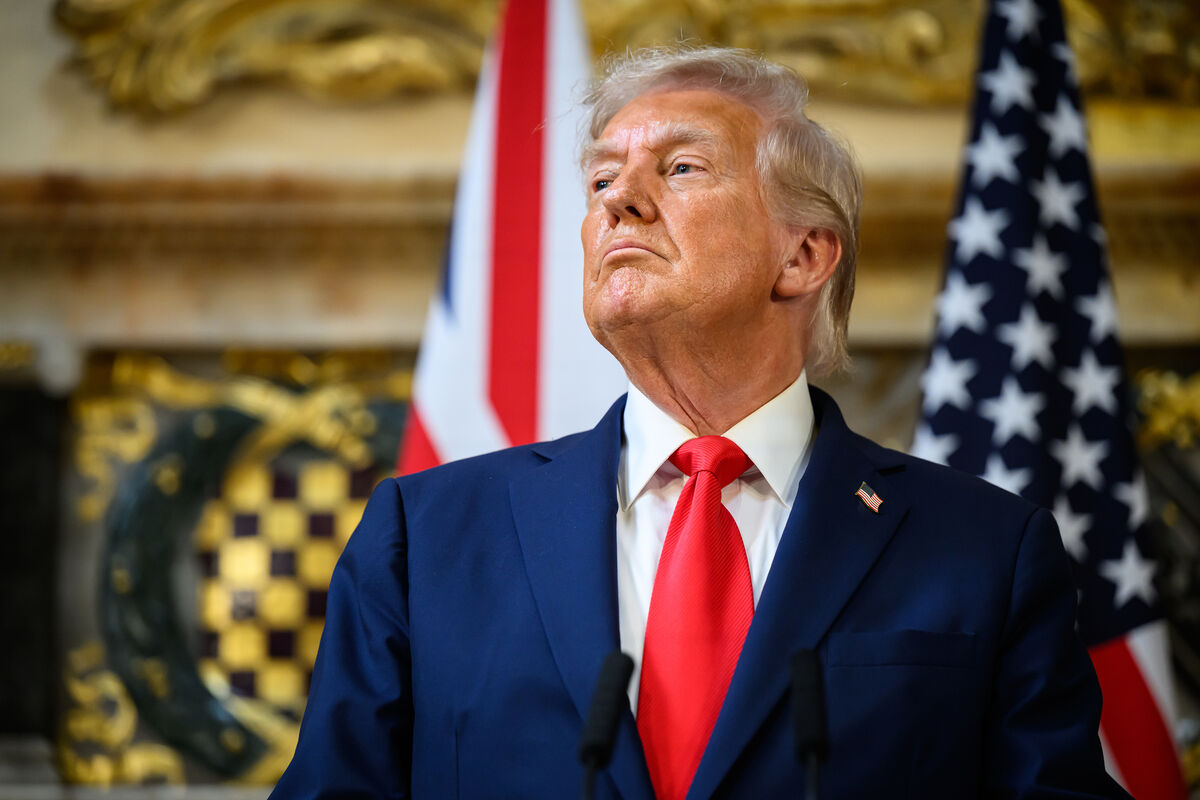
The experiment of Jan. 3 leaves open too many possibilities. Some are more dangerous than others, and certainly among the worst is that the 27-year-old regime might end up tightening its reign. Yet there is an even worse possibility: that Venezuela might lose its political and economic independence. As some headlines report, “Trump Again Floats Idea of Venezuela Becoming America's 51st State.” Given the primary importance of oil interests, we could be turned into a political branch of the United States. I imagine some Venezuelans might like that idea, and others might not. Let's consider the issue.
State of the Union?
For those of us who don’t like it — this author included — there are plenty of arguments against it, especially those rooted in our republican history. It seems rather absurd to suggest that, more than 200 years after our declaration of independence, we would agree to set that freedom aside in favor of another state. And not just any state. [Historically], there was Simón Bolívar’s plan, known as Gran Colombia, in which certain principles would be sacrificed by associating with an equal partner in order to become greater and more powerful; however, doing so with a superpower like the United States, a nation forever mired in war and intervention, would lead us nowhere. Ultimately, it makes little sense to engage in struggles that are not our own.
However, for those who favor becoming a political arm of the United States, it would be very interesting to examine the requirements for doing so, starting with the adoption of its constitution, which sets forth the conditions for admission of a new state.*
It reads as follows:
“Article IV, Section 3, Clause 1:
“New States may be admitted by the Congress into this Union; but no new State shall be formed or erected within the Jurisdiction of any other State; nor any State be formed by the Junction of two or more States, or Parts of States, without the Consent of the Legislatures of the States concerned as well as of the Congress.”
According to that document, those aspiring to initiate the process must meet certain requirements that are somewhat removed from today’s reality, such as having reached a sufficient population, not affecting the territorial integrity of another state, promoting a state constitution subject to a referendum, and others, until admission is granted by an Enabling Act of the United States Congress. The process can begin immediately, given the current and sordid state of our country; however, if it becomes too complicated, there is another alternative to try, the one that applies to Puerto Rico.
A Commonwealth?
To even consider this, one would have to accept that Spain lost a war to the United States and ceded several territories, including Puerto Rico,** which set in motion a long process that began with its complete subjugation to that government. The relationship then evolved over time. For example, in 1900, a law was enacted establishing a civil government, with a governor and an executive council appointed by the U.S. president. In 1917, U.S. citizenship was granted to Puerto Ricans and separating the branches of government, even though the governor and the U.S. president still retained veto power over the island’s legislature. In 1950, the U.S. Congress granted Puerto Rico the right to draft its own constitution.
We are all familiar with the history — following those gradual changes — of that country’s recent struggle to achieve full independence, without reaching a consensus on the matter. That is why it remains a commonwealth. In our case, Spain lost the war and Venezuela achieved its independence well before Puerto Rico did; thus, it would be somewhat cumbersome and quite difficult to present this as an alternative for Venezuela, if it cannot be “part of the Union.”
The Bolivarian Republic?
Quite honestly, it is pointless to waste any language trying to find reasons to oppose the continued existence of the Bolivarian Republic, because there have been many arguments demonstrating the magnitude and extent of the destruction it has caused in every aspect of national life. The current facts alone — such as the state of our economy, our society and our republican institutions — would be enough to prevent it from continuing.
However, you can invoke two additional arguments to support continuing as the Bolivarian Republic. On the one hand, the sad reality is that it has begun to play the role of a ward under a foreign government, a situation that already had the precedent of its submission to the Cuban regime. On the other hand — and in my view, an even stronger reason to prevent its survival — is that it has transformed into something it was never intended to be. Today, it has become the champion of opening up the oil and mining sectors to foreign private capital. It is returning to the very institutions that its founder so vehemently attacked. We prefer, therefore, to uphold the values that led us to establish ourselves as a republic.
The Republic of Venezuela
Returning to what we once were is, I believe, what Venezuelans desire and value most — not only because it would mean moving from an autocratic regime to a democratic one, which would already be significant and open the door to fundamental change — but it would also acknowledge our achievements and our failures. The Republic of Venezuela, conceived by those who opposed the colonial system, whose roots lie in April 19, 1810 and July 5, 1811, remained so named for a long time before being given a surname [Bolivariana]. That same republic survived the calamities of the War of Independence, the establishment of the institutional order of the Republic of Páez, the great rupture caused by the Federal War, two military dictatorships — Generals Juan Vicente Gómez and Marcos Pérez Jiménez — the October Revolution, political sectarianism and coups d’état. Ultimately, it survived the establishment of a democratic system.
It survived with significant achievements in the modernization of our country, as well as periods of oil-fueled opulence and related and repeated crises. It withstood good governments, as well as bad governments that led to a loss of confidence in its fledgling democracy, but it failed to survive the militaristic advance that gave it its surname.
Now it is time to fully review what we did wrong and salvage what we did right that paved the way for many years of existence. The only way to do this is, on the one hand, to provide Venezuelans with true prosperity — not the false prosperity revealed time and again by the oil boom — and, on the other hand, to restore a democratic order that includes everyone and prevents, at all costs, any single party or elite from monopolizing political power — just as the Republic of Venezuela once attempted in that experiment known as the Punto Fijo Pact.
If one could speak of destiny in the most structured way possible, we Venezuelans are bound to the Republic of Venezuela by those years of history, traditions, institutions, shared customs and by the reaching of agreements that that ensured its long-term sustainability. That is the lesson we must follow.
*Editor’s note: The constitutional provision cited here addresses the admission of a new state into the United States; it does not apply to absorbing a sovereign nation as a territory of the United States.
**Translator’s note: The Treaty of Paris, signed by the United States and Spain on Dec. 10, 1898, brought the war to an end. Under this treaty, Spain ceded Puerto Rico, Guam and the Philippines to the United States.
Demasiadas dudas dejan el experimento del 3 de enero. Unas mas peligrosas que otras y desde luego, entre las peores está que el régimen de los 27 años termine consolidándose en el poder, pero hay una peor: que Venezuela termine perdiendo su independencia política y económica si, como indican algunas declaraciones tutelares, como aquella del Estado 51, por ejemplo y lo del predominio del interés petrolero, podamos ser convertidos en una sucursal política de los Estados Unidos. Como imagino que a unos venezolanos les gusta la idea y a otros no consideremos el asunto.
¿ESTADO DE LA UNION?
A los que no nos gusta, como es el caso de quien escribe, sobran argumentos en contra, en especial aquellos que lindan con nuestra historia republicana, pues pareciera algo descabellado plantearse que, después de más de 200 años de la Declaración de Independencia, estemos aceptando declinarla en favor de otro Estado. Y no frente a uno cualquiera, como seria por ejemplo regresar al plan de Bolivar con la Gran Colombia y sacrificar algunos principios para hacernos mas grandes y potentes asociándonos con uno entre iguales, pero hacerlo con una potencia del carácter de los Estados Unidos, enfrascada históricamente en guerras e intervenciones no nos lleva a ninguna parte. En definitiva, en una lucha que no es nuestra no hace mucho sentido.
Sin embargo, para los que les gusta seria muy interesante que se pasearan por los requisitos para adherirse a aquel país, comenzando por la adopción de principio a su Constitución, que es la que pauta como se es admitido. Dice asi:
“Artículo IV, Sección 3, Cláusula 1:”
“El Congreso podrá admitir nuevos estados en esta Unión; pero ningún nuevo estado se formará ni se erigirá dentro de la jurisdicción de otro estado; ni se formará ningún estado mediante la unión de dos o más estados, o partes de estados, sin el consentimiento de las legislaturas de los estados interesados, así como del Congreso.”[1]
Luego de esa primera decisión, quienes aspiren a iniciar el proceso habrán de contar con algunas consideraciones un poco alejadas de la realidad de hoy, como aquellas de haber alcanzado una población suficiente, no afectar la territorialidad de otro Estado, promover una Constitución Estatal, sometida a referendo y otras más, hasta ser admitido por una Ley Habilitante del Congreso de los Estados Unidos. Ya pueden comenzar dentro de este mundo sórdido que vive hoy nuestro país, pero si se les hace muy complicado, hay una alternativa cercana de imitar: la de Puerto Rico.
¿ESTADO LIBRE ASOCIADO?
Para comenzar a pensarla habría que aceptar que España perdió una guerra con los Estados Unidos y le cedió varios territorios, entre ellos el de Puerto Rico[2], lo que determinó un largo proceso que se iniciaba por su completa sujeción a ese gobierno. Luego la relación evoluciona con el tempo. Por ejemplo, en 1900 se promulga una Ley que establece un gobierno civil, con un Gobernador y un Consejo Ejecutivo designados por el presidente de aquel país. En 1917 se promulga otra Ley que le otorga la ciudadanía estadounidense a los puertorriqueños y separó ramas del poder público, aun cuando todavía se conservaba un poder de veto del Gobernador y el presidente de los Estados Unidos sobre la legislatura de ese país. En 1950 el Congreso norteamericano concede a Puerto Rico elaborar una Constitución propia.
Mas allá de estas atribuciones progresivas todos conocemos la historia de la lucha reciente de ese país por lograr su plena independencia, sin obtener un consenso sobre la materia. De allí todavía su nombre de Estado Libre Asociado. En el caso nuestro, España perdió la guerra y Venezuela alcanzo su Independencia bastante antes que Puerto Rico, por lo que resultaría algo engorroso y bastante difícil presentar esta como una alternativa para Venezuela…si no se puede ser “de la Union”.
¿REPUBLICA BOLIVARIANA?
Realmente, perder unas líneas en conseguir razones para oponerse a la permanencia de la República Bolivariana es un contrasentido, ya que se han escrito y vertido tantos y numerosos argumentos para comprobar la magnitud y el grado de destrucción que ha ocasionado en todos los ámbitos de la vida nacional. Bastarían los hechos actuales, como lo es el Estado de nuestra economía, de nuestra sociedad, de las instituciones republicanas para evitar su continuidad.
Sin embargo, se pueden invocar dos argumentos adicionales para sustentar esta tesis. Por un lado, la triste realidad que ha comenzado a representar ese papel de tutelada por un Gobierno extranjero, que ya tenia el precedente de su sumisión al régimen cubano. Por el otro, a nuestro juicio peor aun para evitar su subsistencia, la conversión a lo que nunca quiso ser, hoy día convirtiéndose en el adalid de la apertura petrolera y minera al capital privado extranjero y regresando a las instituciones que con tanta vehemencia atacó su fundador. Preferimos, entonces, reivindicar los valores que nos llevaron a constituirnos en Republica.
LA REPUBLICA DE VENEZUELA.
Regresar a lo que fuimos es lo mas deseable y apreciado, creo, por los venezolanos, no solo porque pasemos de un régimen autocrático a uno democrático que ya sería bastante y abriría las puertas para una transformación de fondo, sino para hacer memoria de logros y fracasos La Republica de Venezuela, ideada por los que se opusieron al sistema colonial, cuyas raíces están en el 19 de abril de 1810 y en el 5 de julio de 1811, asi nombrada permaneció por largo tiempo antes de colocarle un apellido.
Esa misma Republica sobrevivió a las calamidades de la Guerra de Independencia, a la construcción del orden institucional de la Republica de Páez, a la gran ruptura que causó la Guerra Federal, a dos dictaduras militares, Gómez y Pérez Jiménez, a la Revolución de Octubre, al sectarismo político y a golpes de Estado. Al final, a la instalación del sistema democrático.
Sobrevivió con logros importantes de modernización de nuestro país, asi como a momentos de opulencia petrolera y a crisis reiteradas en ese orden. Resistió a buenos y malos gobiernos que causaron la perdida de confianza en su noviciado democrático, pero no logró sobrevivir a la avanzada militarista que le puso el apellido.
Ahora toca revisar a plenitud lo que hicimos mal y rescatar lo que hicimos bien y permitió largos años de existencia. La única manera de hacerlo es, de un lado, darles prosperidad verdadera a los venezolanos, no fingida como varias veces lo reveló el auge petrolero toc y, del otro, retomar un orden democrático que haga participe a todos y evite, a toda costa, que un partido o una elite monopolice el poder político, tal como una vez lo ensayó la República de Venezuela en ese experimento de Pacto que fue Punto Fijo.
Si de destino se pudiera hablar en la forma mas estructurada posible, atados a la Republica de Venezuela estamos los venezolanos por esos años de historia, de tradiciones, de instituciones, de costumbres compartidas y de llegar a acuerdos que le dieron sostenibilidad duradera. Ese es el aprendizaje y la lección que nos a aplicar.
[1][1] Ver artículo en Wikipedia
[2] El Tratado de París , firmado por Estados Unidos y España el 10 de diciembre de 1898, puso fin a la guerra. Mediante este tratado, España cedió Puerto Rico, Guam y Filipinas a Estados Unidos. Librería del Congreso de los Estados Unidos. Publicado por Anna Price, 10.11.2022
This post appeared on the front page as a direct link to the original article with the above link
.