
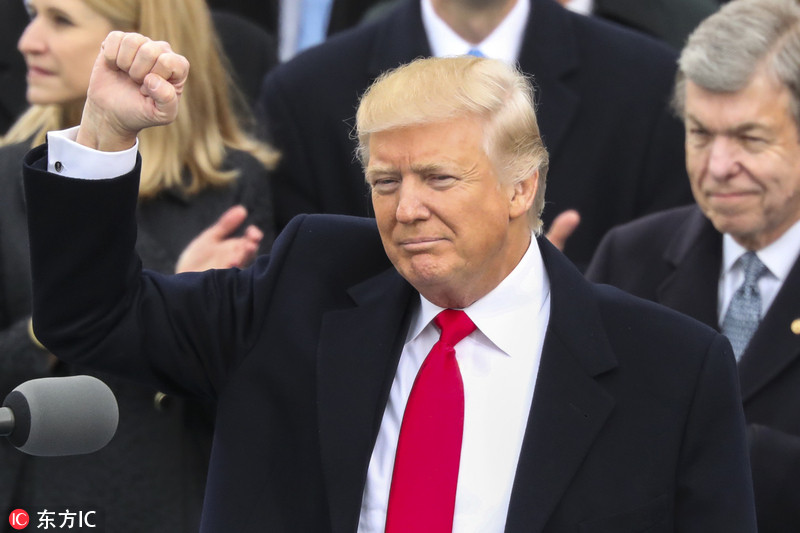
Signals Sent in Trump’s Inaugural Address
The 45th president of the United States, Donald Trump, formally took the oath of office on Jan. 20 in Washington, D.C., or early on the morning of Jan. 21 Beijing time. He gave a strong personal inaugural speech bound to draw complex criticism from within America and abroad.
Trump first attacked previous American domestic policy as he faced several former U.S. presidents, portraying the America before him as completely destitute, and enumerating American defeat on all fronts. He announced that “today we are not merely transferring power from one administration to another, or from one party to another – but we are transferring power from Washington, D.C., and giving it back to you, the American people.”
He vehemently criticized the small group of people in Washington who have reaped the rewards of governance, saying that it would will change right then and there, “because this moment is your moment: it belongs to you.” He continued with the same rhetoric he used during his campaign.
Trump also prominently emphasized patriotism in his speech, reaffirming his campaign advocacy for “America First.” He said that all trade, tax, immigration and foreign relations decisions must be made to benefit American workers and families.
He believes that all countries have the right to prioritize their own interests. America is not seeking to impose its lifestyle on others, “but rather to let it shine as an example for everyone to follow,” Trump said. He called strongly for resistance to the advance of Islamic terror, “which we will eradicate completely from the face of the earth.”
Trump did not mention China or Russia in his speech, nor any other country’s name besides that of the United States.
Our first impression of Trump’s inauguration speech was that while the wording was somewhat more careful, the basic thought behind it was more or less in line with his campaign. In his widely distributed speech, a major portion consisted of complaints and criticism. He is indeed quite unlike any other president before him.
First, he does not focus too much on details, nor on the perceptions of other people or other sides. His speech could have made former President Obama and the sizeable elite present very uneasy; Trump does not care what world powers and people even more distant from him think.
Second, he believes that America’s path domestically and the current world order are both wrong. He promised to fix such large-scale problems.
Third, revitalizing the American economy and improving the lives of the people are his signature goals for governing, and moreover, he seems to believe that the majority of the problems in the American economy are caused by trade policies that are disadvantageous to its interests. He urgently stressed the need to make these policies work better for America.
The goals Trump has laid out are quite grand, as if he wishes to simultaneously unroll a revolution in domestic politics as well as one in international economic norms. Many on the Chinese internet were quick to believe that he wished to begin an American version of the Cultural Revolution. But the American system’s checks on executive authority are fairly numerous, and Trump did not say how he would carry out such a revolution. The greatest motivating force currently on display to the American people is his character’s impetuousness.
Previously, American presidents would make a great effort to repair societal fissures resulting from the campaign season, but it appears that Trump is in no rush to do so. He seems more likely to continue the “revolution” using his influence as president and harnessing the resentment that the lower classes have against the Washington elite. On the other hand, though, his team contains the largest number of economic elite of any government in American history; his stated goals and the people he has commissioned for his government are at odds.
On the world stage, he almost certainly will foment disagreement, if not outright clashes, with some of America’s allies. There is a high chance of a trade war between China and Trump’s America. Previous international associations were marked by a system of government and a world view, but in the Trump era, these lines could become muddled. The national economic interest may well become a much more prominent factor.
Trump and his team have previously spent much time talking about China, but they have yet to establish a clear line on us. They very much wish to expand exports to China and to relocate certain factories in China to America. This is likely what the Trump team is discussing internally about China. It can practically be confirmed that the Taiwan question and other issues are just being used as playing cards.
Trump did not mention “universal values” or geopolitics in his speech at the inauguration. His interests may very well lie elsewhere. But this does not at all imply that his team will not exert greater pressure on China on these fronts. Trump’s policy toward China will be determined by how he perceives the relation of interests between China and America, and whether or not he wishes to attempt a forced change to such relations. If he wishes to press China to yield, we cannot discount the fact that he may have no apprehensions about using every kind of tactic to do so.
Of course, a lot of fire will ignite on Trump’s doorstep. It is quite hard to say when he will finally “get around to China.”
Trump first attacked previous American domestic policy as he faced several former U.S. presidents, portraying the America before him as completely destitute, and enumerating American defeat on all fronts. He announced that “today we are not merely transferring power from one administration to another, or from one party to another – but we are transferring power from Washington, D.C., and giving it back to you, the American people.”
He vehemently criticized the small group of people in Washington who have reaped the rewards of governance, saying that it would will change right then and there, “because this moment is your moment: it belongs to you.” He continued with the same rhetoric he used during his campaign.
Trump also prominently emphasized patriotism in his speech, reaffirming his campaign advocacy for “America First.” He said that all trade, tax, immigration and foreign relations decisions must be made to benefit American workers and families.
He believes that all countries have the right to prioritize their own interests. America is not seeking to impose its lifestyle on others, “but rather to let it shine as an example for everyone to follow,” Trump said. He called strongly for resistance to the advance of Islamic terror, “which we will eradicate completely from the face of the earth.”
Trump did not mention China or Russia in his speech, nor any other country’s name besides that of the United States.
Our first impression of Trump’s inauguration speech was that while the wording was somewhat more careful, the basic thought behind it was more or less in line with his campaign. In his widely distributed speech, a major portion consisted of complaints and criticism. He is indeed quite unlike any other president before him.
First, he does not focus too much on details, nor on the perceptions of other people or other sides. His speech could have made former President Obama and the sizeable elite present very uneasy; Trump does not care what world powers and people even more distant from him think.
Second, he believes that America’s path domestically and the current world order are both wrong. He promised to fix such large-scale problems.
Third, revitalizing the American economy and improving the lives of the people are his signature goals for governing, and moreover, he seems to believe that the majority of the problems in the American economy are caused by trade policies that are disadvantageous to its interests. He urgently stressed the need to make these policies work better for America.
The goals Trump has laid out are quite grand, as if he wishes to simultaneously unroll a revolution in domestic politics as well as one in international economic norms. Many on the Chinese internet were quick to believe that he wished to begin an American version of the Cultural Revolution. But the American system’s checks on executive authority are fairly numerous, and Trump did not say how he would carry out such a revolution. The greatest motivating force currently on display to the American people is his character’s impetuousness.
Previously, American presidents would make a great effort to repair societal fissures resulting from the campaign season, but it appears that Trump is in no rush to do so. He seems more likely to continue the “revolution” using his influence as president and harnessing the resentment that the lower classes have against the Washington elite. On the other hand, though, his team contains the largest number of economic elite of any government in American history; his stated goals and the people he has commissioned for his government are at odds.
On the world stage, he almost certainly will foment disagreement, if not outright clashes, with some of America’s allies. There is a high chance of a trade war between China and Trump’s America. Previous international associations were marked by a system of government and a world view, but in the Trump era, these lines could become muddled. The national economic interest may well become a much more prominent factor.
Trump and his team have previously spent much time talking about China, but they have yet to establish a clear line on us. They very much wish to expand exports to China and to relocate certain factories in China to America. This is likely what the Trump team is discussing internally about China. It can practically be confirmed that the Taiwan question and other issues are just being used as playing cards.
Trump did not mention “universal values” or geopolitics in his speech at the inauguration. His interests may very well lie elsewhere. But this does not at all imply that his team will not exert greater pressure on China on these fronts. Trump’s policy toward China will be determined by how he perceives the relation of interests between China and America, and whether or not he wishes to attempt a forced change to such relations. If he wishes to press China to yield, we cannot discount the fact that he may have no apprehensions about using every kind of tactic to do so.
Of course, a lot of fire will ignite on Trump’s doorstep. It is quite hard to say when he will finally “get around to China.”
Previous article

Next article