
Trump Veni, Vidi, Vici
His presence in Mexico exposes our vulnerability. It represents a capitulation and the weakening of a fundamental obligation, our national representation and the political profile of our president’s leadership. The absence of the leader we need at a time when the main priority is protecting Mexican citizens inside and outside our borders can be keenly felt. Donald Trump’s visit has made that clear, even if the government and other commentators claim that it is merely pragmatism, reconciling with a legitimate candidate who could reach the White House and who could cause economic upheaval in the country. However, there is no political justification for believing that welcoming him to Los Pinos will exorcise the discourse of hate and xenophobia that has led other world leaders to close their doors on him.
There is a strategic error here. First, as soon as Trump’s visit to Mexico was revealed, it was the object of protest due to the absence of voices in favor of it, other than that of the government. Upon confirming his meeting with the Republican candidate, President Peña Nieto said, “I believe in dialogue to promote Mexico’s interests in the world and to protect Mexicans everywhere.” Second, there were warnings from the Democratic candidate, Hillary Clinton, who said that the visit did not make up for years of insults. Trump represents a clear threat, but does Peña Nieto believe that he can win him over during a discussion in Los Pinos? Is there perhaps some agreement that can be reached and prevent the prospect of Trump from translating into economic disaster for the country?
The indignation sparked by Trump’s visit, who has vilified Mexicans in the past, has developed into concern about the elimination of the nationalist conscience of a president who, in the best case scenario, opts for “pragmatism” in the face of the huge onslaught of attacks and threats from his neighbor and main business partner. It is this lack of a forceful response that is the problem Mexicans have with the meeting, when the president previously compared Trump to Hitler and provided a strategy to ward off the danger by changing the ambassador to Washington. This lack of response is also affecting thousands of immigrants who have been threatened by Trump and who see the meeting as a betrayal.
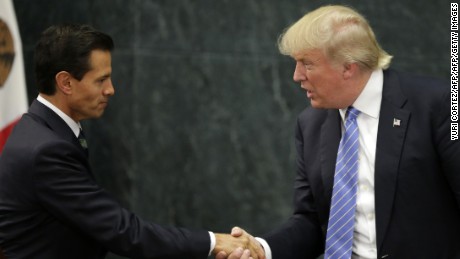
In this meeting, the insults became “misinterpretations” and the stage served as a campaign event for Trump, who reiterated his idea of building a border wall although he softened the previous anti-immigration discourse in his speech on migration policy in Arizona. Still, he did not apologize for his previous statements.
Is it really possible to think that the visit could smooth things over? That the reconciliation will dispel the danger that comes along with his victory? How wide will the rift with the Democrats become? What cost does an agreement with Trump have to the national conscience? Can it be achieved? The diplomatic approach would be to receive Clinton, who is leading in the polls, first, or wait to see who wins the election, perhaps even prioritizing reconciliation with the Republican Party before giving in to threats from an outsider candidate. Our relationship with the U.S. is essential for the well-being of the Mexican people, so the question is whether or not this is the road we should follow to guarantee it or if, on the other hand, we should open the door so that the U.S. can opt for political opportunities in Mexico.
The election of new presidents in the U.S. and in Mexico in 2018 will have serious consequences for bilateral political strategies. The Mexican government’s position has been to remain on the margins of the U.S. electoral process, but yesterday at Los Pinos looked like a Trump campaign event. What has made Peña Nieto change his position? Why run the risk of distancing himself from Clinton when she is ahead in the polls? Will we have to accept that in 2018 the opposition will receive the support of the White House’s new tenant … or do we have it already?
There is a strategic error here. First, as soon as Trump’s visit to Mexico was revealed, it was the object of protest due to the absence of voices in favor of it, other than that of the government. Upon confirming his meeting with the Republican candidate, President Peña Nieto said, “I believe in dialogue to promote Mexico’s interests in the world and to protect Mexicans everywhere.” Second, there were warnings from the Democratic candidate, Hillary Clinton, who said that the visit did not make up for years of insults. Trump represents a clear threat, but does Peña Nieto believe that he can win him over during a discussion in Los Pinos? Is there perhaps some agreement that can be reached and prevent the prospect of Trump from translating into economic disaster for the country?
The indignation sparked by Trump’s visit, who has vilified Mexicans in the past, has developed into concern about the elimination of the nationalist conscience of a president who, in the best case scenario, opts for “pragmatism” in the face of the huge onslaught of attacks and threats from his neighbor and main business partner. It is this lack of a forceful response that is the problem Mexicans have with the meeting, when the president previously compared Trump to Hitler and provided a strategy to ward off the danger by changing the ambassador to Washington. This lack of response is also affecting thousands of immigrants who have been threatened by Trump and who see the meeting as a betrayal.
In this meeting, the insults became “misinterpretations” and the stage served as a campaign event for Trump, who reiterated his idea of building a border wall although he softened the previous anti-immigration discourse in his speech on migration policy in Arizona. Still, he did not apologize for his previous statements.
Is it really possible to think that the visit could smooth things over? That the reconciliation will dispel the danger that comes along with his victory? How wide will the rift with the Democrats become? What cost does an agreement with Trump have to the national conscience? Can it be achieved? The diplomatic approach would be to receive Clinton, who is leading in the polls, first, or wait to see who wins the election, perhaps even prioritizing reconciliation with the Republican Party before giving in to threats from an outsider candidate. Our relationship with the U.S. is essential for the well-being of the Mexican people, so the question is whether or not this is the road we should follow to guarantee it or if, on the other hand, we should open the door so that the U.S. can opt for political opportunities in Mexico.
The election of new presidents in the U.S. and in Mexico in 2018 will have serious consequences for bilateral political strategies. The Mexican government’s position has been to remain on the margins of the U.S. electoral process, but yesterday at Los Pinos looked like a Trump campaign event. What has made Peña Nieto change his position? Why run the risk of distancing himself from Clinton when she is ahead in the polls? Will we have to accept that in 2018 the opposition will receive the support of the White House’s new tenant … or do we have it already?
Previous article
Next article
