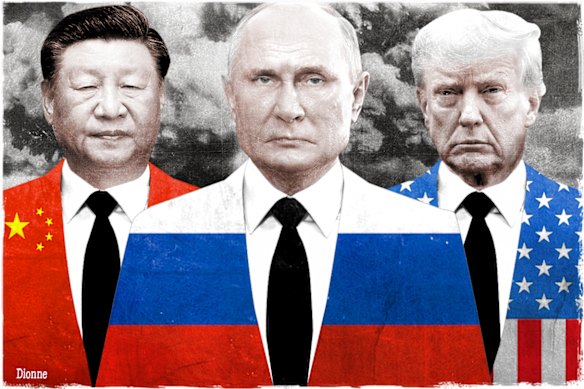
… And Trump Fell Asleep

Published in El Colombiano
(Colombia) on 24 November 2026
by Beatriz de Majo (link to originallink to original)
Translated from by Lucy Preston. Edited by Patricia Simoni.
While Trump and Putin returned to Washington and Moscow to deal with the devastating domestic economic effects of their respective wars, which are taking a heavy political toll on them, the Chinese president returned home with the image of a world leader.

On the surface, Xi Jinping seemed to emerge victorious from the trilateral meeting with Vladimir Putin and Donald Trump in Shenzhen. The hosts controlled the public messaging so intensely that neither the Russian nor the American guest came across well. When it comes to putting on a show, nobody can beat Beijing. Especially now, when it’s so crucial for the Chinese government to convince the world — and its own people — that its leader, Xi, is the strongest on the planet. It was necessary for them to focus more on the scale of the events than on their substance, to highlight which of the three giants was calling the shots.

Important current global issues were discussed in various forums held on Chinese-controlled territory. Attention was given to the evolution of Asia-Pacific Economic Conference, the leading economic forum in Asia and the Pacific, and to issues like global nuclear disarmament, in which China is not a major player. Behind the scenes, the three leaders reviewed the global situation, but neither Putin nor Trump did anything other than update their counterparts on the progress — or lack thereof — of military operations, without demanding, as analysts has predicted, that decisive positions be taken. Absolutely no mention of a “Yalta 2.0.”

What was the visible constant in this “entente cordiale,” reminiscent of the diplomatic agreement that ended World War I? The effort made by the Chinese government to ensure that Xi projected restraint, stability and continuity in the face of two counterparts debilitated by their military campaigns. This is recounted by Lucas de la Cal, an expert at El Mundo, who described the meeting as a “meeting that Xi has taken advantage of to project the image of China as an indispensable power, without whose participation major international conflicts can no longer be resolved nor the future of the world order decided.”

While the other leaders returned to Washington and Moscow to deal with the devastating domestic economic effects of their respective wars — which are taking a political toll on them — Xi remained facing his country with the image of the “indispensable” world leader.

Many will argue that Russia was the winner. The Economist asserts that Putin managed to shed his status as a pariah at this summit, but this is a fleeting truth, as it will only be the case for as long as Xi allows it. Moscow depends on Beijing for trade, particularly in oil, as well as for technology, industry and geopolitical support.

In his dealings with the U.S., Xi applied his age-old wisdom to champion diplomacy within the framework of “a constructive strategic stability relationship.” Trump boarded Air Force One convinced that Xi is willing to tolerate certain measures on Washington’s part, believing that a positive relationship could help moderate other harmful actions. Retaliation is not a weapon China will use in its technological or trade disputes. There was nothing epic about these last few days of interaction. Perhaps that is why the U.S. president had that irreverent, uncontrollable dream that was captured by journalists’ cameras.


...Y Trump se quedó dormido
Mientras Trump y Putin regresaban a Washington y a Moscú a lidiar con los devastadores efectos económicos internos de las respectivas guerras que les pasan costosas facturas políticas, el chino quedaba de cara a su país con la imagen del líder mundial.
En apariencia Xi Jinping salió victorioso del triálogo con Vladimir Putin y Donald Trump en Shenzhen. Los extremos comunicacionales fueron tan cuidados por los anfitriones que ni el invitado ruso ni el americano se anotaron muchos puntos a favor. En materia de espectacularidad, nadie es capaz de ganarle a Pekín. Menos en esta hora, en que para el gobierno chino es preciso atornillar, ante el mundo y los propios, la percepción de que su líder Xi Jinping es el más sólido del planeta. Fue preciso imprimir mucho volumen a los actos, más que al contenido, para poner de relieve quien de los tres colosos fue el que llevó la batuta.
Importantes temas de la actualidad mundial se barajaron en varios foros que ocurrieron en predios controlados por China. Se dio atención a la evolución de la APEC, el principal foro económico de Asia y el Pacífico y a los asuntos como el desarme nuclear global en los cuales China no es un jugador de grandes ligas. Tras bambalinas, los tres líderes revisaron la coyuntura global, pero ni Putin ni Trump hicieron otra cosa que actualizar a los interlocutores sobre los avances –o estancamiento- de las acciones armadas, sin exigir, como predecían analistas, que se asumieran posiciones determinantes. Ni hablar de un Yalta 2.0.
¿Cuál fue la constante visible de este “entente cordiale” parecido al acuerdo diplomático de fin de la primera guerra mundial? El esfuerzo desplegado por el gobierno chino por conseguir que Xi proyectara mesura, estabilidad y continuidad frente a dos interlocutores debilitados por sus iniciativas bélicas. Lo relata Lucas de la Cal, experto de El Mundo, cuando califica el encuentro como una “cita que Xi ha de aprovechar para proyectar la imagen de China como una potencia imprescindible, sin cuya participación ya no pueden resolverse los grandes conflictos internacionales ni decidirse el futuro del orden mundial”.
Mientras los interlocutores de Xi regresaban a Washington y a Moscú a lidiar con los devastadores efectos económicos internos de las respectivas guerras que les pasan facturas políticas, el chino quedaba de cara a su país con la imagen del líder mundial “sine qua non”.
No faltará quien argumente que Rusia fue ganador. The Economist asegura que Putin logró en esta Cumbre deslastrarse de su condición de paria, pero es una verdad perecedera, ya que será así solo mientras Xi se lo permita. Moscu depende de Pekin en materia comercial –particularmente petrolera- tecnológica e industrial y de respaldo geopolítico.
Frente a EE. UU., Xi usó su milenaria sapiencia para enarbolar una diplomacia de “entendimiento proactivo dentro de un marco de estabilidad estratégica”. Trump tomó el Air Force 1 convencido de que Xi está dispuesto a tolerar ciertas medidas de parte de Washington por considerar que un contacto favorable puede servir para moderar otras acciones perjudiciales. La retaliación no es un arma que será utilizada por China ante sus conflictos tecnológicos ni comerciales. Nada hubo de épico en estos días de interacción. Por ello quizá ocurrió el irreverente e incontenible sueño del presidente de EE. UU. captado por las cámaras de los periodistas.
This post appeared on the front page as a direct link to the original article with the above link .

Hot this week

Canada: Why the US Midterms Might Have Ended JD Vance’s Presidential Hopes

Austria: The Trump-Xi-Putin Summit Has Exposed the Weakness of the Great Powers

Saudi Arabia: American Voter Behavior amid Flexible Societal Pluralism

Australia: Inside Trump’s Orbit, Albanese Is Learning the Rules of a Changing World

Australia: Donald Trump, Xi Jinping and Vladimir Putin’s Summit Had More Flair than Substance

Topics

Austria: The Trump-Xi-Putin Summit Has Exposed the Weakness of the Great Powers

Ireland: Let’s Hope Trump Is Willing To Take His Winnings and Go Quietly

Switzerland: Donald Trump, a Willing Victim in a Spectacle Directed by Beijing and Moscow in Shenzhen

Saudi Arabia: American Voter Behavior amid Flexible Societal Pluralism

Canada: US Democrats Can’t Save Us from Trump

Canada: Why the US Midterms Might Have Ended JD Vance’s Presidential Hopes

Canada: Canada Needs a Constituency Strategy for the New Congress

Related Articles

Austria: The Trump-Xi-Putin Summit Has Exposed the Weakness of the Great Powers

Ireland: Let’s Hope Trump Is Willing To Take His Winnings and Go Quietly

Switzerland: Donald Trump, a Willing Victim in a Spectacle Directed by Beijing and Moscow in Shenzhen

Canada: US Democrats Can’t Save Us from Trump