
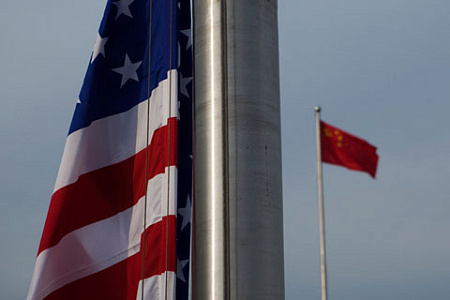
The US Fears China More Than Russia
In their analyses, American military experts have somewhat changed the rating of threats to the United States. Now China and Russia, specifically in that order, are considered the main military adversaries, though a year ago it was the reverse. On top of it all, the overseas media have recently turned to an analysis of various World War III scenarios. One of the most popular is a scenario in which the U.S. fights Russia and China at the same time. In this variation, several alliances on which Washington, in the opinion of some analysts, might rely, are examined.
The publication Foreign Policy writes, “Russia and especially China are the only countries that could plausibly take over and hold the territory of Washington’s allies and partners in the face of U.S. resistance ... If China did so in the Western Pacific, it could dominate the world’s largest and most economically dynamic region. If Russia did so, it could fracture NATO and open Eastern Europe to Russian dominance. Beijing and Moscow must therefore not be given such an opening, which is why Washington must focus not on abstract metrics of its military superiority...but on its and its allies’ clear ability to defeat major aggression in specific, plausible scenarios..."
The publication The National Interest stresses, “U.S. and Western European clumsiness ... has produced an increasingly thick and consequential alignment between two geopolitical rivals, Russia and China.” And, finally, according to the document known as President Donald Trump’s National Security Strategy, “China and Russia challenge American power, influence, and interests, attempting to erode American security and prosperity.”
The American Conservative website emphasizes that the current confrontation between the U.S. and Russia may turn into an allied relationship in the long term, whereas China and Russia will most likely become rivals in the distant future. It notes that because of prevailing economic and geopolitical circumstances, Beijing, previously perceived as a strategic partner, is quickly becoming Washington’s mortal enemy. At the same time, Russia, which today thanks to propaganda, is perceived by a majority of the U.S. population as “aggressive by nature,” will in the very same America be proclaimed a country of exceptionally friendly people in a decade or two.
In the event of war, everything is clear as far as the European theater of operations is concerned. Here NATO’s modern plans are practically the same as those developed back in the 70s of the last century in relation to the USSR. In reality, even the outright hawks in the West don’t believe that Russia would ever try to take over Europe. Washington is more worried about the capabilities of a Russia-China tandem in the Pacific region. At the same time, some strategists set as the objective the severing of the maritime trade routes between China and the Old World. Actions in two main directions are under consideration.
First, there is the route around Eurasia from the Pacific Ocean to the Indian Ocean and then through the Suez Canal to the Mediterranean. In the opinion of the Americans, what is important here is an alliance with India, which, with its combat fleet, can help the U.S. Navy (the 7th and 5th Fleets) sink Chinese and Russian warships. The Americans, it seems, aren’t interested in India’s opinion on the matter. Washington’s traditional allies in the Gulf region, as well as Australia and New Zealand, are ignored.
The second direction is the Northern Sea Route, which for the purposes of a naval blockade of China would be controlled by the U.S. 7th and 3rd Fleets and the naval forces of Japan, South Korea and possibly Taiwan.
However, these insinuations crash up against the probability that any scenario would instantaneously escalate into an exchange of nuclear strikes, which is indisputably the most powerful weapon against the outbreak of World War III.
Previous article

Next article
