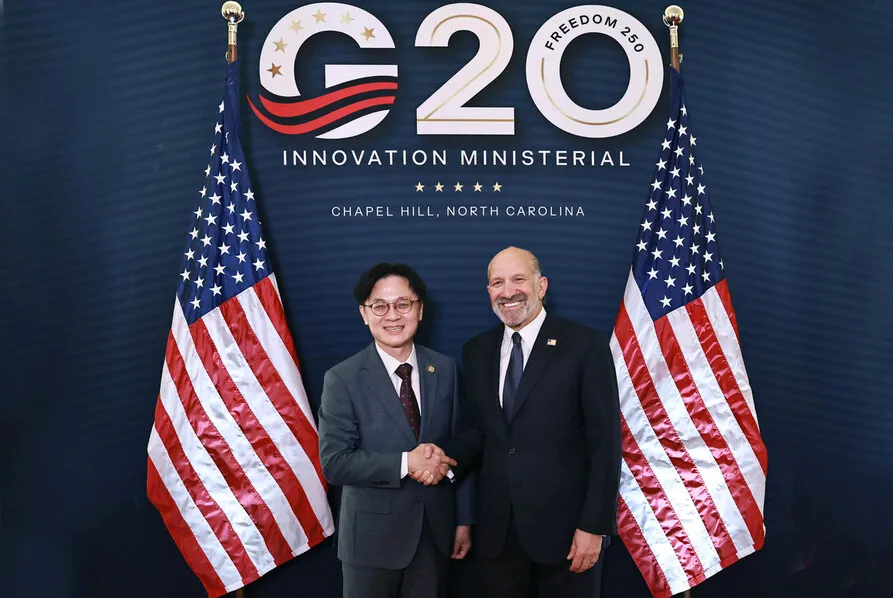
On Sept. 4, a high-ranking official at the Blue House* said that the semiconductor issue would be on the table in talks over South Korea’s investment in the United States. The comment is noteworthy because it came as Commerce Secretary Howard Lutnick was demanding that Samsung Electronics and SK Hynix build memory chip plants in the United States. This is a new demand that was not included in the memorandum of understanding signed last November, in which South Korea agreed to invest $350 billion in the United States. The United States should understand that continually adding new demands will only destroy trust between allies.
The senior Blue House official said, “It is true that semiconductors are included in the list of issues to be discussed regarding investment in the United States.” Earlier, on Sept. 2, Lutnick said semiconductors would be subject to a “targeted, thoughtful tariff policy,” with tariff exemptions for companies that manufacture in the United States and tariffs imposed on those that do not. He also confirmed reports that finished products containing semiconductors, including laptops, would face higher tariffs.
Last year’s tariff agreement contained no mention of constructing memory chip plants. However, the agreement included a provision stating that “the United States intends to provide terms for such … tariffs on Korea that are no less favorable than terms that may be offered in a future agreement covering a volume of semiconductor trade at least as large as Korea’s, as determined by the United States.” At the time, this was interpreted as referring to the tariff rate that would be imposed on Taiwan.
But in January of this year, Taiwan promised to invest $500 billion in the United States in exchange for a reduced reciprocal tariff rate of 15%. In addition, Taiwanese companies in the process of building new plants in the United States would be permitted to import up to 2 1/2 times their production capacity without paying tariffs. Companies with completed plants would be allowed to import up to 1 1/2 times their production capacity without tariffs. But at the time of the agreement, South Korea did not consent to adding memory chip plant construction to the deal.
The United States is pursuing the establishment of semiconductor manufacturing bases within its borders, as semiconductors are a key element in securing dominance in artificial intelligence. President Donald Trump has even set a goal of increasing semiconductor self-sufficiency from around 10% to 50% during his term. South Korea must prepare thoroughly, as the United States will most certainly put immense pressure on us. We are not without leverage. If high tariffs are placed on memory chips, the burden will first fall on U.S. Big Tech. The United States is already experiencing “chipflation,” in which soaring prices for dynamic random-access memory chips are driving up the prices of finished products, and data center companies are facing cash-flow pressure. Congress’ intervention when Apple intended to use Chinese-made memory chips, encouraging the company to use products from U.S. allies instead, shows South Korea’s strategic value. We must persuade the United States that high tariffs would hurt both its competitiveness in AI and its approach to China. We must create a “win-win” model, in which South Korea provides the United States with a stable supply of memory chips in exchange for tariff exemptions.
*Editor's note: The Blue House is South Korea's executive office and residence of the president.
청와대 고위 관계자가 지난 4일 대미 투자 협상에 반도체 문제도 올라 있다고 밝혔다. 하워드 러트닉 미국 상무장관이 삼성전자와 에스케이(SK)하이닉스에 메모리 반도체 공장의 미국 건설을 요구하는 상황에서 나온 발언이라 주목된다. 이는 지난해 11월 한·미가 체결한 3500억달러 규모의 대미 투자 양해각서에 없던 새 요구다. 끝없이 새로운 요구를 얹는 것은 동맹 사이의 신뢰를 허무는 일임을 미국은 알아야 한다.
청와대 고위 관계자는 “대미 투자 이슈 중에는 반도체도 논의 대상인 게 사실”이라고 말했다. 앞서 러트닉 장관은 지난 2일 반도체 관세가 “표적화되고 신중한 정책이 될 것”이라며, 미국에서 생산하는 기업에는 관세를 감면하고, 그러지 않는 기업에는 부과하겠다고 말했다. 노트북처럼 반도체가 들어간 완제품에도 고율 관세를 매길 방침이라는 보도도 사실이라고 했다.
지난해 관세합의에는 메모리 공장 건설 내용이 없다. 다만, 반도체 관세는 ‘한국보다 반도체 교역 규모가 큰 국가(사실상 대만)와 미국이 향후 체결할 합의보다 불리하지 않은 조건’을 제공한다는 단서가 들어 있다. 당시 이것은 대만에 부과될 ‘관세율’을 뜻하는 것으로 해석됐다. 그런데 대만은 올해 1월 상호관세를 15%로 낮추는 대신 5천억달러 규모 대미 투자를 약속하고, 미국 내 신규 공장 건설 기간에는 생산능력의 2.5배, 완공 뒤에는 신규 생산능력의 1.5배까지 관세를 면제받는 구조를 받아들였다. 하지만 우리가 이렇게 메모리 공장 건설을 연계하는 것까지 당시 합의해준 것은 아니다.
미국은 인공지능(AI) 패권을 거머쥐기 위해 핵심 원자재인 반도체의 제조 거점을 자국 안에 두려 하고 있다. 도널드 트럼프 대통령은 10% 수준인 반도체 자립도를 임기 내 50%로 높이겠다는 목표까지 제시한 바 있다. 우리나라를 거세게 압박할 것이 분명한 만큼 철저히 대비해야 한다. 지렛대가 없지 않다. 메모리에 고율 관세를 매기면 그 부담은 미국 빅테크에 먼저 돌아간다. 이미 디램 값 급등으로 완제품 가격까지 밀어올리는 ‘칩플레이션’이 미국 물가를 자극하고, 데이터센터 업체들은 현금흐름 압박을 받고 있다. 애플이 중국산 메모리를 쓰려 하자 미 의회가 동맹국 제품을 쓰라고 제동을 건 것도 우리의 전략적 가치를 방증한다. 고율 관세는 미국의 인공지능 경쟁력과 중국 견제 전략에 동시에 역행한다는 점을 설득해야 한다. 미국에 안정적 공급을 보장하는 대신 관세 면제를 확보하는 ‘윈윈’ 모델을 제안할 필요가 있다.
This post appeared on the front page as a direct link to the original article with the above link
.