
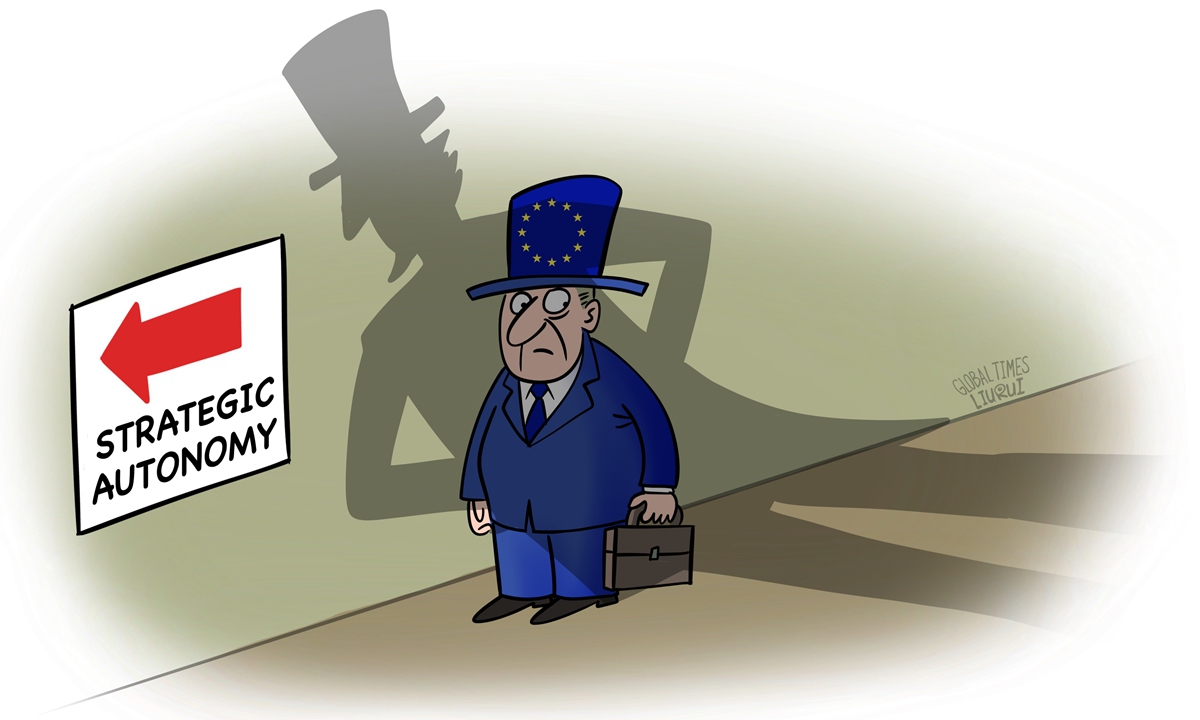
Trump’s Defeat Doesn’t Mean Europe Is Safe
For all the joy over the election result, the U.S. can bring large swaths of Europe’s infrastructure to a standstill if it chooses. Gaining independence will take major projects and investment.
Most Europeans feel as though a weight has been lifted from their shoulders — an entire mountain range, not just a boulder. The Democrats’ victory in this week’s U.S. midterm elections has shown that American democracy is not a lost cause. Could this put trans-Atlantic relations back on track: no more blackmail, no more tariffs?
There is little reason for optimism right now. Europe’s problems have not been solved. As long as the continent depends almost entirely on the U.S. in key sectors of its economy, it will remain vulnerable to blackmail. In many areas, things are actually moving in the wrong direction: The war in Ukraine has prompted Europe to largely free itself from dependence on Russian gas — a sensible move. But it now imports three times as much liquefied natural gas from the U.S. The European Union has traded one dependency for another.
The artificial intelligence revolution relies largely on U.S. technology. When European banks such as UniCredit and Deutsche Bank build their AI infrastructure, they buy from Google and IBM. When airlines offer internet access on board, they turn to Elon Musk’s Starlink. U.S. tech giants Amazon Web Services, Microsoft Azure and Google Cloud take 70% of the revenue in Europe’s cloud services market. And when the continent rearms, it buys American.
US Tech Giants Dominate
Austria cannot even introduce a tax on parcel deliveries without an outcry because so many customers order from Amazon. When the U.S. sanctions Europeans, as it recently did with judges at the International Criminal Court in The Hague, it can ensure that those affected can no longer write emails, make credit card payments or open Microsoft Word.
Trump is too often dismissed as a crackpot. That obscures the fact that he has notched up significant successes. He used threats to force through a trade deal with the EU that is excellent from the U.S. perspective; Americans raised their tariffs on European imports, while the Europeans had to lower theirs. A government that collects tariffs needs less tax revenue from its citizens. No Democrat will be quick to undo that. Trump got his way because Europe had little with which to counter him; was it supposed to threaten to ship fewer Audis to the U.S.?
Put Up the Money
To stop being pushed around in pursuit of U.S. interests, Europe needs a concerted strategy for greater independence. The continent must invest and regulate. Europe has its own AI provider in Mistral. Why are banks and financial services firms left free to choose where they build their AI infrastructure? Both private and public capital must be mobilized to fund data centers and the energy transition.
It may sound lofty, but renewables really do provide “energy for freedom,” as Austrian Foreign Minister Beate Meinl-Reisinger recently put it. Curbing the influence of tech bros and their platforms is long overdue. Fighting for Europe’s independence makes more than economic sense. It could give centrist parties a way to push back against extremists, who are all too fond of cozying up to autocrats in Washington and Moscow.
Previous article