
Fascism, Then and Now
Fascism was not a “youthful indiscretion” of capitalism from some distant time and place. It is back in vogue. Contrary to Hollywood propaganda — a form of psychological warfare disguised as entertainment — fascism was never exclusively European or Japanese, nor was it something “exotic” or alien to American society. The emblematic case of Henry Ford — the archetype of the American way of life and a self-confessed antisemite — and his ties to Adolf Hitler illustrates this point.
From Ronald Reagan to Donald Trump, fascist and neo-fascist currents have reemerged. Some consist of lumpen elements and eccentrics — colorful, buffoonish, marginal figures. Others, however, occupy center stage. Trump and Marco Rubio are the public face of the deep state — what Dwight D. Eisenhower called the “military-industrial complex,” now transformed into the “military-industrial-technological complex.”
The concept of “fascism” cannot be reduced to a sepia-toned photograph of Benito Mussolini’s troops taking Rome in 1922, or of Hitler’s Nazis rising to power in Germany in 1933. Fascism is a much broader and more flexible political and cultural category. It is continually recast in different forms within each society and culture. The United States is no exception. According to the Argentine philosopher León Rozitchner, the United States today is a continuation of the German Third Reich.
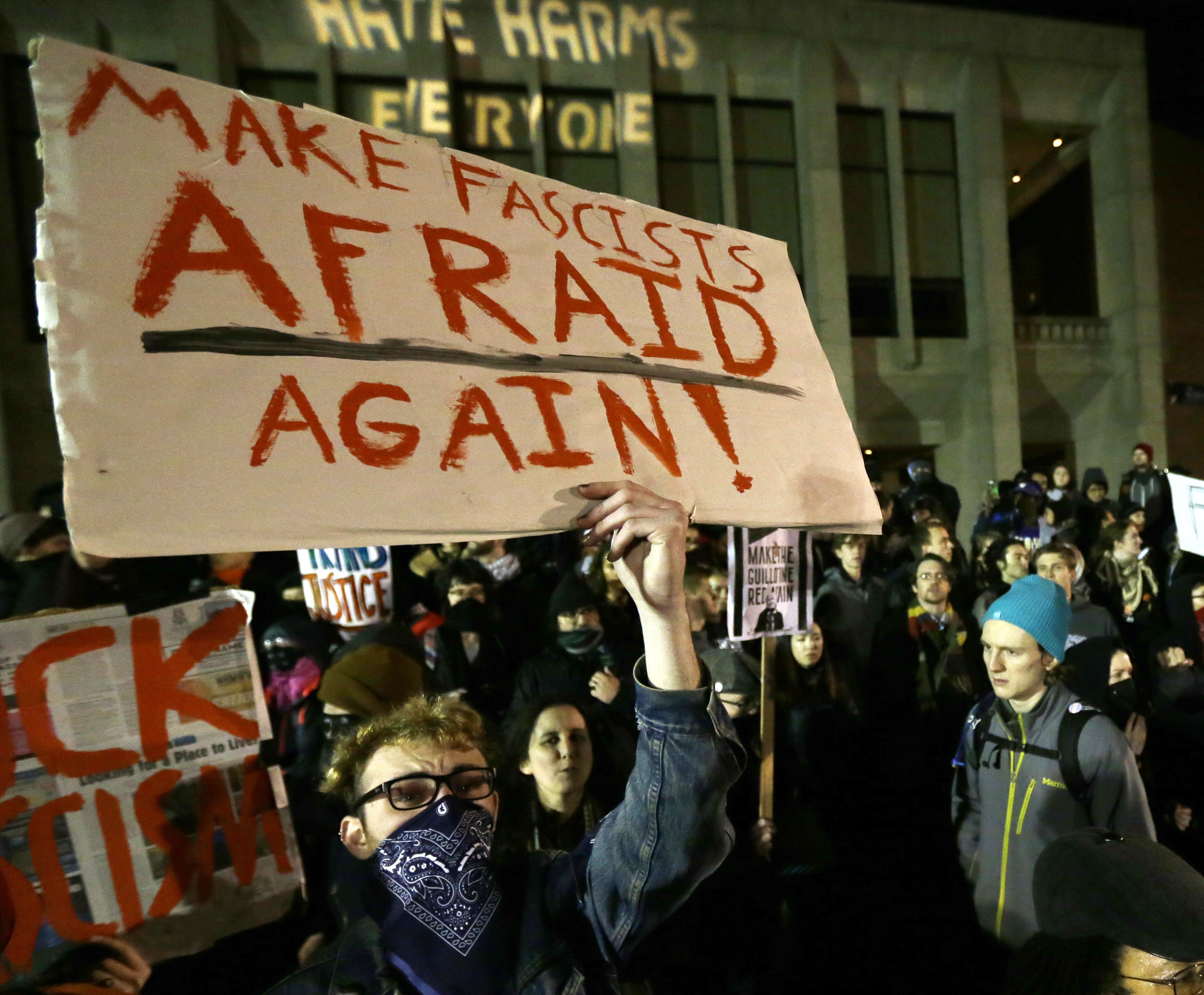
That is why the judicial persecution of the anti-fascist movement is intensifying in the United States. It extends from political, cultural and street-level social movements (such as “Antifa” in the United States) to digital collectives (such as Autistici/Inventati in Italy) and independent information websites (such as La Haine in Spain).
This explains the scandalous disparity between the lenient, accommodating sentences handed down to those who stormed the U.S. Capitol and the harsh, “exemplary” treatment of ICE critics.
The people whom Trump’s far right and his advisers label “terrorists” are, in reality, dissidents of any kind who reject white supremacy or the delusional Monroe Doctrine. Trump sees communists and “terrorists” (quotation marks, please!) under his bed and even in his neighbor’s window. It is all exaggerated — bizarre and circus-like. It reflects an irrational panic about dissent. Behind the tough-guy facade is a weak and impotent old man who has been convicted multiple times of sexual offenses by U.S. courts.
Karl Popper (and George Soros) bored us with their “open society.” George Orwell, a writer who received money from Anglo-American counterintelligence, did as well. They were obsessed with “totalitarianism.” Trump — heir to the Ku Klux Klan, Henry Ford, Joe McCarthy and Reagan — embodies the nightmare that kept Popper and Orwell awake, but at a higher level: He added technology. Stale, moth-eaten American fascism has been reborn as Fascism 2.0, accompanied by the “neo-reactionary” ideologues of artificial intelligence (supporters of a supposed “Dark Enlightenment”) and the mass-surveillance programs exposed by Edward Snowden. It is all blended together in the mayonnaise-and-jam smoothie known as “libertarian economics,” the most extreme and vulgar form of neoliberalism. Even Milton Friedman has gone out of fashion.
The United States has descended into this dystopian nightmare for many reasons: the global crisis of capitalism, the geopolitical challenge posed by BRICS, the overproduction of capital, underconsumption among the population, the rise of fictitious capital, the demographic and public health crises, and the climate emergency. … Too many crises unfolding at once!
Trump, allegedly linked to a depraved figure such as Jeffrey Epstein (most likely an extortion agent for Israeli intelligence), has certain lumpen traits. But even if the military-industrial-technological complex were to replace him with a polished, “reasonable,” well-educated professor, the crisis would remain unchanged. The same applies to genocidal and neocolonial wars, such as those waged by the Zionist state in West Asia.
I do not want to be pessimistic, but contemporary imperialism offers no “gentle” way out. World War III, in its technical and military dimension, is just around the corner. It does not depend on the conduct of those who lead the United States, Israel, NATO or Ukraine. It can be stopped only through a difficult and complex alliance or coordination among dissident movements within these powers of Western imperialism, the subjugated peoples of the Global South, and the new challenges led by the BRICS nations. These three pillars do not share the same ideology, culture or causes. That is why achieving such coordination is so difficult.
World War III has already begun on an earlier battlefield: communication, ideology and culture. What Pentagon ideologues call the “culture war” — misinterpreting and distorting Antonio Gramsci — is, in reality, a psychological and ideological war. Demoralizing people and persuading them that all resistance is impossible are political and military objectives.
Both Gramsci and his mentor, Vladimir Lenin, warned that popular movements must resist on every front without restricting themselves to a single method of struggle. The confrontations of this new generation are hybrid. But the outcome, I think, believe and hope, remains open. Nothing is decided forever. There is hope.
From Ronald Reagan to Donald Trump, fascist and neo-fascist currents have reemerged. Some consist of lumpen elements and eccentrics — colorful, buffoonish, marginal figures. Others, however, occupy center stage. Trump and Marco Rubio are the public face of the deep state — what Dwight D. Eisenhower called the “military-industrial complex,” now transformed into the “military-industrial-technological complex.”
The concept of “fascism” cannot be reduced to a sepia-toned photograph of Benito Mussolini’s troops taking Rome in 1922, or of Hitler’s Nazis rising to power in Germany in 1933. Fascism is a much broader and more flexible political and cultural category. It is continually recast in different forms within each society and culture. The United States is no exception. According to the Argentine philosopher León Rozitchner, the United States today is a continuation of the German Third Reich.
That is why the judicial persecution of the anti-fascist movement is intensifying in the United States. It extends from political, cultural and street-level social movements (such as “Antifa” in the United States) to digital collectives (such as Autistici/Inventati in Italy) and independent information websites (such as La Haine in Spain).
This explains the scandalous disparity between the lenient, accommodating sentences handed down to those who stormed the U.S. Capitol and the harsh, “exemplary” treatment of ICE critics.
The people whom Trump’s far right and his advisers label “terrorists” are, in reality, dissidents of any kind who reject white supremacy or the delusional Monroe Doctrine. Trump sees communists and “terrorists” (quotation marks, please!) under his bed and even in his neighbor’s window. It is all exaggerated — bizarre and circus-like. It reflects an irrational panic about dissent. Behind the tough-guy facade is a weak and impotent old man who has been convicted multiple times of sexual offenses by U.S. courts.
Karl Popper (and George Soros) bored us with their “open society.” George Orwell, a writer who received money from Anglo-American counterintelligence, did as well. They were obsessed with “totalitarianism.” Trump — heir to the Ku Klux Klan, Henry Ford, Joe McCarthy and Reagan — embodies the nightmare that kept Popper and Orwell awake, but at a higher level: He added technology. Stale, moth-eaten American fascism has been reborn as Fascism 2.0, accompanied by the “neo-reactionary” ideologues of artificial intelligence (supporters of a supposed “Dark Enlightenment”) and the mass-surveillance programs exposed by Edward Snowden. It is all blended together in the mayonnaise-and-jam smoothie known as “libertarian economics,” the most extreme and vulgar form of neoliberalism. Even Milton Friedman has gone out of fashion.
The United States has descended into this dystopian nightmare for many reasons: the global crisis of capitalism, the geopolitical challenge posed by BRICS, the overproduction of capital, underconsumption among the population, the rise of fictitious capital, the demographic and public health crises, and the climate emergency. … Too many crises unfolding at once!
Trump, allegedly linked to a depraved figure such as Jeffrey Epstein (most likely an extortion agent for Israeli intelligence), has certain lumpen traits. But even if the military-industrial-technological complex were to replace him with a polished, “reasonable,” well-educated professor, the crisis would remain unchanged. The same applies to genocidal and neocolonial wars, such as those waged by the Zionist state in West Asia.
I do not want to be pessimistic, but contemporary imperialism offers no “gentle” way out. World War III, in its technical and military dimension, is just around the corner. It does not depend on the conduct of those who lead the United States, Israel, NATO or Ukraine. It can be stopped only through a difficult and complex alliance or coordination among dissident movements within these powers of Western imperialism, the subjugated peoples of the Global South, and the new challenges led by the BRICS nations. These three pillars do not share the same ideology, culture or causes. That is why achieving such coordination is so difficult.
World War III has already begun on an earlier battlefield: communication, ideology and culture. What Pentagon ideologues call the “culture war” — misinterpreting and distorting Antonio Gramsci — is, in reality, a psychological and ideological war. Demoralizing people and persuading them that all resistance is impossible are political and military objectives.
Both Gramsci and his mentor, Vladimir Lenin, warned that popular movements must resist on every front without restricting themselves to a single method of struggle. The confrontations of this new generation are hybrid. But the outcome, I think, believe and hope, remains open. Nothing is decided forever. There is hope.
Previous article
Next article
