
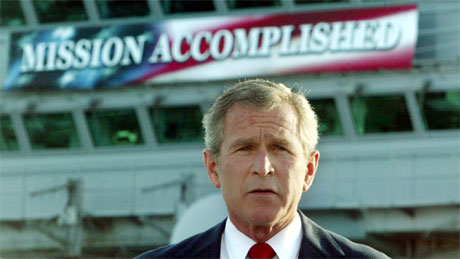
Bush: MissionAccomplished
Bush: Mission Accomplished
WASHINGTON Between the US election on November 4th and the inauguration of the new president, the world still has 77 days of George W. Bush.
Luckily, Bush cant escape so easily from history: in the world of images, or the cultural industry, using the term coined by Horkheimer and Adorno, Bush has just been exposed for the public at large in the wonderful W., the new film from director Oliver Stone (JFK, Doors, and others). Josh Brolin gives a spectacular and moving performance as the President.
Even without taking shots at Bush (just the opposite, in fact), the film ends up hammering one more nail in the coffin of the president and his family, pecking around the edges of power in the United States for 200 years now.
Its also a slap to the face of Americans who have twice elected him. The second time, by the way, Bush and the Republicans achieved a complete victory in 2004: in the popular vote, in the Electoral College, in the House and Senate, and in the majority of the states.
Between Bushs reelection and the end of his second term now, the US went from the heights of unilateralism, arrogance, and the use of force to an unprecedented appeal for international cooperation. If countries could go broke, Bushs America would be the most spectacular case of bankruptcy in contemporary history.
In four years, the United States and Bushs fortunes went from flying to failing, with a strong negative push coming from the Presidents commands and his tiny and obtuse nucleus of power.
In 2003 and 2004, I had the privilege of witnessing in Washington both the events preceding the War in Iraq as well as, more closely, Bushs reelection.
The United States was a different country. Distinguished newspapers unquestioningly believed in everything the President said. People stocked water, food, and batteries in their houses at every sign of a new terrorist catastrophe. The Patriot Act permitted the monitoring of millions of telephone lines of everyday Americans, and the government filled the atmosphere with the most potent fear it could create.
That is how Bush was reelected: by duping the easily-dupable US media outlets with horror stories.
Stones film is just one sign of the sad end of the Bush era. The once-all-powerful presidential advisors with the power to record, interrogate, and apprehend are now exposed in ways unimaginable four years ago. Even the headlines of Washingtons largest (free) gay newspaper, Blade, is questioning this week: Is Condie Gay? in reference to none other than the US Secretary of State, Condoleezza Rice assumed to be a spinster like our mayor Kassab.
The Bush years also left indelible cracks in the worlds largest economy. We found out that the US would barely have grown in the last five years were it not for consumer spending. Surprise: that was financed by flimsy credit spiraling into nothing. The country is bankrupt.
The worlds richest (?) and most militarily powerful nation has been caught with its pants down at the end of Bushs reign. Even the most coherent solution for the current crisis directly injecting capital into banks came from overseas, from the United Kingdom, and was replicated in the US. Its all unbelievable.
But, as extraordinary is it all seems, Bushs arrogance and ignorance may have rendered an immense service.
If the US grows close to nothing in the next two or three years, which is very possible, the Chinese economy will have expanded from one-third the size of the American to one-half. Various other emerging economies will also gain larger slices of the global participatory pie. At least in economic terms, it will be a whole new world.
And that just might be Bushs greatest legacy.
WASHINGTON Between the US election on November 4th and the inauguration of the new president, the world still has 77 days of George W. Bush.
Luckily, Bush cant escape so easily from history: in the world of images, or the cultural industry, using the term coined by Horkheimer and Adorno, Bush has just been exposed for the public at large in the wonderful W., the new film from director Oliver Stone (JFK, Doors, and others). Josh Brolin gives a spectacular and moving performance as the President.
Even without taking shots at Bush (just the opposite, in fact), the film ends up hammering one more nail in the coffin of the president and his family, pecking around the edges of power in the United States for 200 years now.
Its also a slap to the face of Americans who have twice elected him. The second time, by the way, Bush and the Republicans achieved a complete victory in 2004: in the popular vote, in the Electoral College, in the House and Senate, and in the majority of the states.
Between Bushs reelection and the end of his second term now, the US went from the heights of unilateralism, arrogance, and the use of force to an unprecedented appeal for international cooperation. If countries could go broke, Bushs America would be the most spectacular case of bankruptcy in contemporary history.
In four years, the United States and Bushs fortunes went from flying to failing, with a strong negative push coming from the Presidents commands and his tiny and obtuse nucleus of power.
In 2003 and 2004, I had the privilege of witnessing in Washington both the events preceding the War in Iraq as well as, more closely, Bushs reelection.
The United States was a different country. Distinguished newspapers unquestioningly believed in everything the President said. People stocked water, food, and batteries in their houses at every sign of a new terrorist catastrophe. The Patriot Act permitted the monitoring of millions of telephone lines of everyday Americans, and the government filled the atmosphere with the most potent fear it could create.
That is how Bush was reelected: by duping the easily-dupable US media outlets with horror stories.
Stones film is just one sign of the sad end of the Bush era. The once-all-powerful presidential advisors with the power to record, interrogate, and apprehend are now exposed in ways unimaginable four years ago. Even the headlines of Washingtons largest (free) gay newspaper, Blade, is questioning this week: Is Condie Gay? in reference to none other than the US Secretary of State, Condoleezza Rice assumed to be a spinster like our mayor Kassab.
The Bush years also left indelible cracks in the worlds largest economy. We found out that the US would barely have grown in the last five years were it not for consumer spending. Surprise: that was financed by flimsy credit spiraling into nothing. The country is bankrupt.
The worlds richest (?) and most militarily powerful nation has been caught with its pants down at the end of Bushs reign. Even the most coherent solution for the current crisis directly injecting capital into banks came from overseas, from the United Kingdom, and was replicated in the US. Its all unbelievable.
But, as extraordinary is it all seems, Bushs arrogance and ignorance may have rendered an immense service.
If the US grows close to nothing in the next two or three years, which is very possible, the Chinese economy will have expanded from one-third the size of the American to one-half. Various other emerging economies will also gain larger slices of the global participatory pie. At least in economic terms, it will be a whole new world.
And that just might be Bushs greatest legacy.