
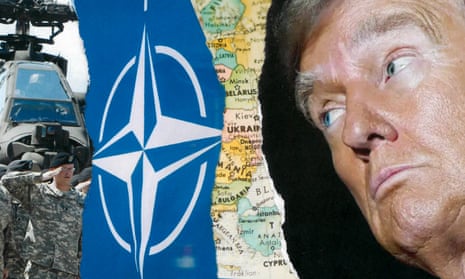
Trump Is Already Halfway Gone from NATO
Published in Frankfurter Allgemeine Zeitung
(Germany) on 29 March 2026
by Nikolas Busse (link to
original)
Trump is increasingly casting doubt on the Western Alliance. It’s not lost on Vladimir Putin. Germany must not underestimate this rift.
German politicians tend to delude themselves where Donald Trump and NATO are concerned. The German chancellor is no exception. Germans assume the mere existence of legal obstacles to the United States cutting its troop numbers in Europe or withdrawing from the NATO alliance means that the worst-case scenario won't happen.
They live in hope that Congress will act to keep Trump within NATO if push comes to shove. And couldn't another U.S. president come along after Trump who will place greater store by the trans-Atlantic alliance again? German Chancellor Friedrich Merz posed this rhetorical question at an event hosted by the Frankfurter Allgemeine newspaper on Friday.
’Why Would We Be There for Them If They're Not There for Us?’
It’s a formulaic way of thinking that ignores the crux of the problem. Effective deterrence relies on convincing a potential aggressor it will meet significant military resistance. It is the very principle Trump keeps calling into question. Regarding the Europeans, Trump is asking, “Why would we be there for them if they're not there for us? They weren't there for us.”
Remarks like that show that Trump is already half gone from NATO. That’s because he’s effectively saying that American readiness to come to its allies’ defense is no longer measured by a collective pledge to Article 5 of NATO, but rather by how willing the allies are to provide mutual assistance in other theaters — currently the war on Iran.
Vladimir Putin will be taking careful note of this. It makes it more likely that the United States would stay out of things if Putin attacked a NATO territory. After all, Congress is not the U.S. commander in chief; the president is. Given Trump’s vindictive, grudge-bearing nature, we could continue to feel the consequences of this latest crisis inside the alliance long after the war with Iran is over.
The fact that Trump is now criticizing Merz personally proves that Berlin cannot underestimate the significance of this rift. Until now, the German chancellor has maintained a reasonably stable working relationship with this difficult president. It would be preferable to keep it that way. Evidently, the assistance Germany and other European allies have offered in relation to the Strait of Hormuz is not enough.
German politicians tend to delude themselves where Donald Trump and NATO are concerned. The German chancellor is no exception. Germans assume the mere existence of legal obstacles to the United States cutting its troop numbers in Europe or withdrawing from the NATO alliance means that the worst-case scenario won't happen.
They live in hope that Congress will act to keep Trump within NATO if push comes to shove. And couldn't another U.S. president come along after Trump who will place greater store by the trans-Atlantic alliance again? German Chancellor Friedrich Merz posed this rhetorical question at an event hosted by the Frankfurter Allgemeine newspaper on Friday.
’Why Would We Be There for Them If They're Not There for Us?’
It’s a formulaic way of thinking that ignores the crux of the problem. Effective deterrence relies on convincing a potential aggressor it will meet significant military resistance. It is the very principle Trump keeps calling into question. Regarding the Europeans, Trump is asking, “Why would we be there for them if they're not there for us? They weren't there for us.”
Remarks like that show that Trump is already half gone from NATO. That’s because he’s effectively saying that American readiness to come to its allies’ defense is no longer measured by a collective pledge to Article 5 of NATO, but rather by how willing the allies are to provide mutual assistance in other theaters — currently the war on Iran.
Vladimir Putin will be taking careful note of this. It makes it more likely that the United States would stay out of things if Putin attacked a NATO territory. After all, Congress is not the U.S. commander in chief; the president is. Given Trump’s vindictive, grudge-bearing nature, we could continue to feel the consequences of this latest crisis inside the alliance long after the war with Iran is over.
The fact that Trump is now criticizing Merz personally proves that Berlin cannot underestimate the significance of this rift. Until now, the German chancellor has maintained a reasonably stable working relationship with this difficult president. It would be preferable to keep it that way. Evidently, the assistance Germany and other European allies have offered in relation to the Strait of Hormuz is not enough.
Previous article

Next article