
It’s Time To End the Farce of America’s ‘Military-Affiliated Blacklist’
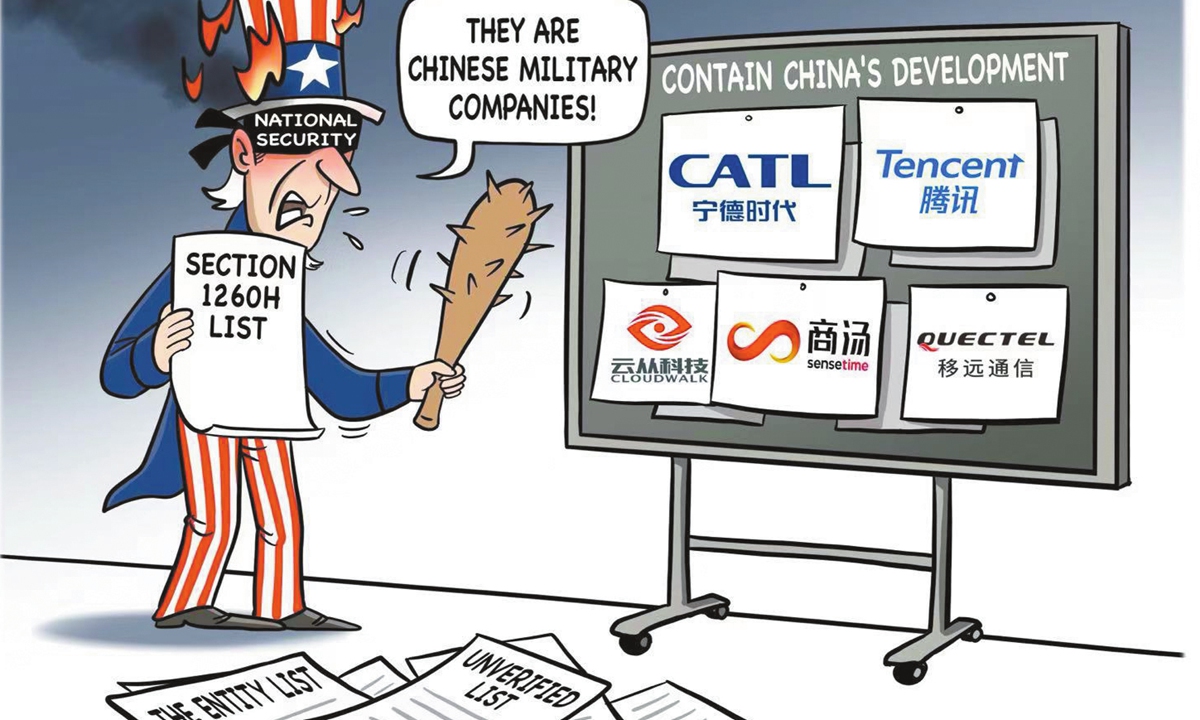
This week, the U.S. Pentagon updated its “list of Chinese military-affiliated companies.” On it are 188 Chinese entities — from artificial intelligence, e-commerce platforms, electric vehicles, batteries, semiconductors and robotics to biomedicine, its scope has relentlessly expanded. This is an increasingly preposterous farce. Once again, the U.S. has escalated its unjustifiable suppression of Chinese enterprises and issued a flagrant challenge to global trade and market regulations. It’s worth mentioning that this year’s list is in keeping with the times by pointedly including a large number of leading enterprises in high-end manufacturing and emerging technology fields. The list increasingly resembles an honor roll of China’s modern powerhouses.
The ridiculousness of the “military-affiliated blacklist” is, first, in its arbitrary criteria and warped logic. An e-commerce platform, a search engine and a renewable energy vehicle company — none of which is in any way affiliated with the military — have been labeled as Chinese military assets and threats to American national security because they made a few achievements in artificial intelligence, cloud computing or battery technology. In essence, these companies are guilty until proven innocent on the basis of having aroused the envy of others. If you are a Chinese tech company and competitive on a global scale, then you are naturally “military-related,” and there are sufficient grounds for the Pentagon to threaten or enact unilateral sanctions.
By this standard, is it a threat to other countries’ national security if Coca-Cola develops a program evaluating global consumer tastes? U.S. tech giants have signed massive contracts with the Pentagon, and tech magnates often enter and exit a revolving door system of senior executive roles. How many countries should add them to their list of “threats to national security”? This kind of robber baron logic only lets its own technology stay in the lead and restricts other countries’ development and progress. These blatant double standards expose an inveterate supremacist mindset, which in itself is a flagrant violation of international standards of fairness.
This edition of the Pentagon’s list encompasses virtually all emerging industries with strategic value, including artificial intelligence, renewable energy, unmanned systems, aerospace, cloud computing, and semiconductors, and it includes a large number of Chinese enterprises at the forefront of technology sectors. This indicates that Washington is not targeting any individual Chinese tech company, but rather considers Chinese technology as a whole to be strategic competition. Essentially, the Pentagon’s blacklist is a tacit acknowledgment of China’s technological progress and reveals its dread of Chinese capabilities. They worry because their position of technological hegemony faces Chinese challengers in every field and Chinese startups now have the ability to reshape the global industrial landscape. In other words, this blacklist has long since superseded its original military-related purpose and is now Washington’s means of tracking and suppressing China’s top enterprises.
This vain attempt to stem the tide of China’s development with an administrative list is doomed to failure. The blacklist’s ever-widening reach just underscores the embarrassing truth: the Americans’ method of targeting specific Chinese companies has failed utterly. This is because the emergence of Chinese enterprise is holistic; competition within the market increases its overall innovative capacity. The developmental trajectories of China’s renewable energy vehicle, battery and artificial intelligence industries have provided ample evidence. Cutting down one company means many more will spring up, and suppressing one sector means the entire industrial chain will isolate and become self-reliant. In the short term, this tactic may indeed increase pressure on Chinese competitors, but in the long term it will undermine the openness and innovative efficiency of global industrial chains. The Pentagon is far from ensuring security. It is disrupting normal cross-border commercial cooperation, threatening the international economic and trade order, and introducing artificial risk to global economic stability.
It’s time to end the face of America’s “military-affiliated blacklist.” The evidence shows the blacklist cannot block China’s steady progress toward technological self-sufficiency, nor can it reverse the genuine U.S. market demand for high-quality Chinese products. This blacklist will be a testament to how Chinese enterprises are constantly overcoming both technological barriers and foreign blockades in their race for the newest means of production.
The ridiculousness of the “military-affiliated blacklist” is, first, in its arbitrary criteria and warped logic. An e-commerce platform, a search engine and a renewable energy vehicle company — none of which is in any way affiliated with the military — have been labeled as Chinese military assets and threats to American national security because they made a few achievements in artificial intelligence, cloud computing or battery technology. In essence, these companies are guilty until proven innocent on the basis of having aroused the envy of others. If you are a Chinese tech company and competitive on a global scale, then you are naturally “military-related,” and there are sufficient grounds for the Pentagon to threaten or enact unilateral sanctions.
By this standard, is it a threat to other countries’ national security if Coca-Cola develops a program evaluating global consumer tastes? U.S. tech giants have signed massive contracts with the Pentagon, and tech magnates often enter and exit a revolving door system of senior executive roles. How many countries should add them to their list of “threats to national security”? This kind of robber baron logic only lets its own technology stay in the lead and restricts other countries’ development and progress. These blatant double standards expose an inveterate supremacist mindset, which in itself is a flagrant violation of international standards of fairness.
This edition of the Pentagon’s list encompasses virtually all emerging industries with strategic value, including artificial intelligence, renewable energy, unmanned systems, aerospace, cloud computing, and semiconductors, and it includes a large number of Chinese enterprises at the forefront of technology sectors. This indicates that Washington is not targeting any individual Chinese tech company, but rather considers Chinese technology as a whole to be strategic competition. Essentially, the Pentagon’s blacklist is a tacit acknowledgment of China’s technological progress and reveals its dread of Chinese capabilities. They worry because their position of technological hegemony faces Chinese challengers in every field and Chinese startups now have the ability to reshape the global industrial landscape. In other words, this blacklist has long since superseded its original military-related purpose and is now Washington’s means of tracking and suppressing China’s top enterprises.
This vain attempt to stem the tide of China’s development with an administrative list is doomed to failure. The blacklist’s ever-widening reach just underscores the embarrassing truth: the Americans’ method of targeting specific Chinese companies has failed utterly. This is because the emergence of Chinese enterprise is holistic; competition within the market increases its overall innovative capacity. The developmental trajectories of China’s renewable energy vehicle, battery and artificial intelligence industries have provided ample evidence. Cutting down one company means many more will spring up, and suppressing one sector means the entire industrial chain will isolate and become self-reliant. In the short term, this tactic may indeed increase pressure on Chinese competitors, but in the long term it will undermine the openness and innovative efficiency of global industrial chains. The Pentagon is far from ensuring security. It is disrupting normal cross-border commercial cooperation, threatening the international economic and trade order, and introducing artificial risk to global economic stability.
It’s time to end the face of America’s “military-affiliated blacklist.” The evidence shows the blacklist cannot block China’s steady progress toward technological self-sufficiency, nor can it reverse the genuine U.S. market demand for high-quality Chinese products. This blacklist will be a testament to how Chinese enterprises are constantly overcoming both technological barriers and foreign blockades in their race for the newest means of production.
Previous article
Next article