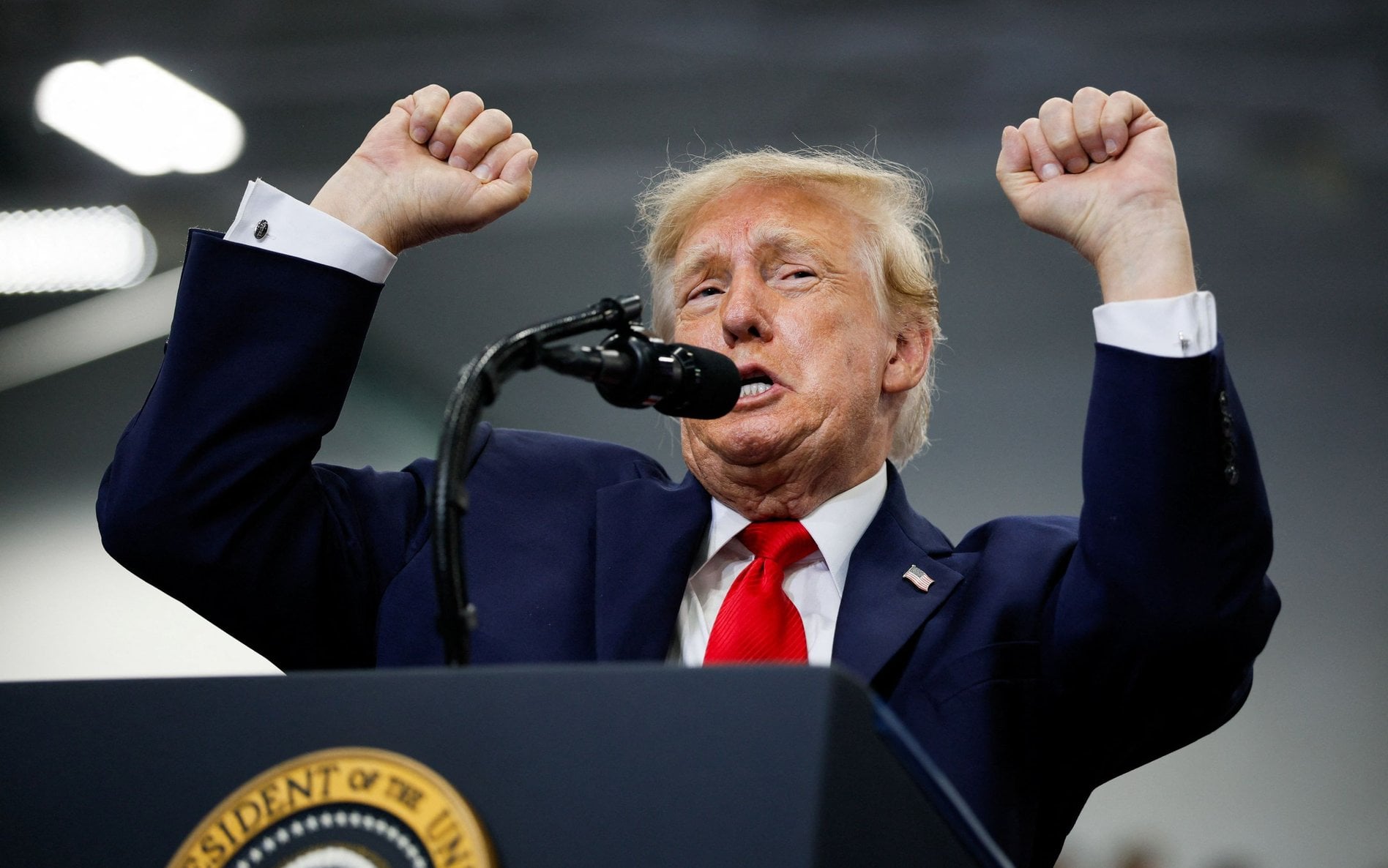
The U.S. president's actions, though sometimes brutal, lead to unexpected results.
Donald Trump has an extraordinary talent for clouding the picture and complicating matters that should be obvious. Although we know perfectly well that the war in the East could end immediately if only Vladimir Putin stopped attacking Ukraine, and if he withdrew his troops from its territory and stopped directing drones and ballistic missiles at it, the U.S. president holds a different opinion.
When asked a few days ago if the agreement he reached with Russia regarding diesel exports would not prolong the war, he stated that Volodymyr Zelenskyy had already had many opportunities to end the war but decided not to do so. Let's take a closer look at this for a moment.
Rising Fuel Prices. Trump Won't Admit He Made a Mistake
The CNN journalist's question was entirely justified. The West unanimously imposed sanctions on Russia to indirectly avoid financing its aggression against Ukraine. This is why the European Union, which was still buying raw materials from Russia before the invasion, began to turn away from it. Thanks to EU decisions, the EU countries are to completely phase out imports of raw materials from Russia, and many countries have made a complete turnaround in the last four years regarding the directions from which they import oil and gas. Yes, parties like the Alternative for Germany advocate for a return to the good old days when the German economy was fueled by cheap Russian raw materials, but time cannot be turned back. And the lack of cheap gas from Russia is not the only problem for the German economy.
Yet Trump could not admit that by paying billions to Putin for diesel fuel, he was giving him financial breathing room that could allow him to wage his war even longer. Just as he had stated earlier, the war in the Persian Gulf is not the reason for high fuel prices, but rather Ukrainian attacks on Russian refineries. Therefore, he repeatedly appealed to Zelenskyy to cease attacks, and this week even announced an energy ceasefire, which, however, largely proved to be a fiction. There have also been reports that the Starlink system has stopped working for objects moving at high speeds, which could mean that the Ukrainians will not be able to use it in systems with which they conduct attacks deep into Russia.
Because Trump cannot admit his mistake, that fuel prices are skyrocketing in the U.S., and diesel fuel is close to record high levels. He cannot say it's his fault, because in February, against warnings from the army, he attacked Iran hand-in-hand with Israeli Prime Minister Benjamin Netanyahu, so the Iranians, for the first time since the Islamic Revolution, dared to block the Strait of Hormuz, through which a large part of the world's oil and gas transport passed.
NATO Defense Spending. Trump's Threats Have Been Effective
The absurdity of this situation also lies in the fact that exactly one month ago, Trump himself signed a bill, prepared by Senator Lindsey Graham, imposing punitive 100% tariffs on countries that still import gas and oil from Russia, with the possibility of increasing them to 500%. The regulations, which will formally come into effect on Sunday, Oct. 18, also included measures intended to target the shadow fleet that Russia illegally uses to export raw materials. And it is precisely because of this law, which was supported by senators from both parties, that Trump's diesel deal with Putin is being criticized.
It should be noted that Trump's actions, though sometimes brutal, lead to unexpected results. In the corridors of the Warsaw Security Forum, I spoke with an important NATO military official who pointed out that the current White House resident's earlier threats to withdraw the U.S. from NATO if other members didn't stop "free-riding" had led to a true renaissance of European defense. "President Barack Obama appealed for increased spending in a very polite manner, but it yielded no results. Today we are in a completely different place," the officer explained.
And although Europe is likely still very far from the strategic autonomy once dreamed of by the French and Germans — and how dependent we are, for example, on the air, logistical, and transport capabilities of the U.S. — was described in his autobiography by former NATO chief Jens Stoltenberg. Nevertheless, if current efforts are maintained, Europe will indeed, in some time, not rely solely on the American umbrella but will be able to defend itself.
US, Russia and Ukraine. What Cards Zelenskyy Has
The NATO doctrine of victory, just presented at the Warsaw Security Forum, is a direct consequence of these changes. Previously, after a potential attack on your alliance, you had to dig in and wait for help from allies, primarily Americans. The new defense doctrine is already different. The highest NATO commander, American Gen. Alexus Grynkewich, presented it on Monday. First, one must deter with one's potential but also with one's readiness for an immediate military response. Second, the plans assume stopping the very first strike so that the enemy cannot occupy positions on NATO territory. Third, NATO must weaken the further attack and, if necessary, strike at the rear of the aggression.
WSF participants wondered if Grynkewich was speaking on his own behalf or on behalf of his superior — Trump. And who will have more to say in the event of potential aggression against NATO: a general or a president? Or perhaps the question is poorly phrased? Could it be that Trump's anti-NATO actions have made NATO stronger than ever before?
Could the same apply to Ukraine? Although a year ago in February, Trump told Zelenskyy in the Oval Office that he had no cards, his irritation with the Ukrainian president now shows how important a tool for pressuring Russia's policy, but also Trump himself, is the ability to destroy Russian refineries. And perhaps this very possibility will sooner or later become the card that allows a fair peace to be negotiated. It would be another Trump paradox.
*Editor's note: This article is available in its original language with a paid subscription.
Michał Szułdrzyński: Paradoks Trumpa. Jego działanie może uratować NATO
Działania prezydenta USA, choć czasami brutalne, prowadzą do niespodziewanych rezultatów.
Donald Trump ma niezwykły talent do zaciemniania obrazu sytuacji i gmatwania spraw, które powinny być oczywiste. Choć wiemy doskonale, że wojna na wschodzie mogłaby się zakończyć natychmiast, gdyby tylko Władimir Putin przestał atakować Ukrainę, gdyby wycofał swoje wojska z jej terytorium i przestał kierować na nią drony i rakiety balistyczne, prezydent USA ma inne zdanie.
Zapytany kilka dni temu, czy porozumienie, jakie zawarł z Rosją w sprawie eksportu oleju napędowego, nie przedłuży wojny, stwierdził, że to Wołodymyr Zełenski już wiele razy miał możliwość doprowadzić wojnę do końca, ale zdecydował się tego nie robić. Przyjrzyjmy się temu na moment trochę bliżej.
Wzrost cen paliw. Donald Trump nie może przyznać się do błędu
Pytanie dziennikarza CNN było jak najbardziej zasadne. Zachód solidarnie wprowadzał sankcje na Rosję, by pośrednio nie finansować jej agresji na Ukrainę. To dlatego Unia Europejska, która przed inwazją wciąż kupowała w Rosji surowce, zaczęła się od niej odwracać. Dzięki decyzjom UE, kraje Unii mają w 100 proc. odejść od importu surowców z Rosji, wiele krajów zaś w ciągu ostatnich czterech lat dokonało całkowitego przewrotu, jeśli idzie o kierunki, z jakich sprowadzają ropę i gaz. Owszem, partie takie jak AfD postulują powrót do starego dobrego świata, w którym niemiecka gospodarka napędzana była tanimi rosyjskimi surowcami, ale czasu cofnąć się nie da. A brak taniego gazu z Rosji nie jest jedynym problemem niemieckiej gospodarki.
Trump nie mógł jednak przyznać, że płacąc miliardy Putinowi za olej napędowy, daje mu finansowy oddech, który może sprawić, że będzie mógł jeszcze dłużej prowadzić swoją wojnę. Tak samo, jak wcześniej stwierdził, że to nie wojna w Zatoce Perskiej jest powodem wysokich cen paliw, ale ukraińskie ataki na rosyjskie rafinerie. Dlatego też kilkakrotnie apelował do Zełenskiego, by ten zaprzestał ataków, a w tym tygodniu nawet ogłosił energetyczne zawieszenie broni, które jednak w znacznej mierze okazało się fikcją. Pojawiły się też doniesienia, że system Starlink przestał działać dla obiektów poruszających się z dużymi prędkościami, co może oznaczać, że Ukraińcy nie będą go mogli używać w systemach, za pomocą których przeprowadzają ataki w głąb Rosji.
Bo Trump nie może się przyznać do błędu, że w USA szaleją ceny paliw, a olej napędowy jest blisko rekordowo wysokich wskaźników. Nie może powiedzieć, że to jego wina, ponieważ w lutym, wbrew ostrzeżeniom płynącym z armii, pod rękę z izraelskim premierem Benjaminem Netanjahu zaatakował Iran, więc Irańczycy po raz pierwszy od rewolucji islamskiej odważyli się na zablokowanie cieśniny Ormuz, przez którą przepływała duża część światowego transportu ropy i gazu.
Wydatki na obronność w NATO. Groźby Donalda Trumpa przyniosły skutek
Absurd tej sytuacji polega też na tym, że dokładnie miesiąc temu sam Trump podpisał ustawę przygotowaną przez senatora Lindseya Grahama, nakładającą karne 100-proc. cła na kraje, które wciąż importują gaz i ropę z Rosji, z możliwością podniesienia ich do 500 proc. Przepisy, które formalnie wejdą w życie w niedzielę 18 października, zawierały też rozwiązania mające uderzyć we flotę cieni, którą Rosja nielegalnie eksportuje surowce. I to właśnie z powodu tej ustawy, którą poparli senatorowie obu partii, krytykowane jest dieselowe porozumienie Trumpa z Putinem.
Trzeba jednak zauważyć, że działania Trumpa, choć czasami brutalne, prowadzą do niespodziewanych rezultatów. W kuluarach Warsaw Security Forum (WSF) rozmawiałem z jednym z ważnych natowskich wojskowych, który zwrócił uwagę, że wcześniejsze deklaracje obecnego mieszkańca Białego Domu grożące wycofaniem się Stanów z NATO, jeśli pozostali członkowie nie skończą swojej „jazdy na gapę”, doprowadziły do prawdziwego renesansu europejskiej obronności. – Prezydent Obama apelował o zwiększenie nakładów w sposób bardzo uprzejmy, ale nie przyniosło to żadnych rezultatów. Dziś jesteśmy w zupełnie innym miejscu – tłumaczył ów oficer.
I choć pewnie Europa jest jeszcze bardzo daleko wyśnionej niegdyś przez Francuzów i Niemców autonomii strategicznej (to, jak uzależnieni jesteśmy choćby od sił powietrznych, logistycznych i transportowych USA, opisywał w swej autobiografii były szef NATO Jens Stoltenberg), to jednak jeśli obecne wysiłki zostaną utrzymane, Europa rzeczywiście nie będzie za jakiś czas polegać wyłącznie na amerykańskim parasolu, ale będzie mogła bronić się sama.
USA, Rosja i Ukraina. Jakie karty ma Wołodymyr Zełenski
Przedstawiona właśnie na WSF natowska doktryna zwyciężania jest właśnie konsekwencją tych zmian. Wcześniej po ewentualnym ataku na państwa sojuszu, należało się okopać i czekać na pomoc sojuszników, przede wszystkim Amerykanów. Nowa doktryna obronna jest już inna. Przedstawił ją w poniedziałek najwyższy dowódca NATO, amerykański generał Alexus Grynkewich. Po pierwsze, trzeba odstraszać swoim potencjałem, ale też gotowością do natychmiastowej odpowiedzi militarnej. Po drugie, plany zakładają zatrzymanie już pierwszego uderzenia, by wróg nie mógł zająć pozycji na terytorium NATO. Po trzecie, NATO musi osłabić dalszy atak, a jeśli będzie taka potrzeba, uderzyć w zaplecze agresji.
Uczestnicy WSF zastanawiali się, czy Grynkewich mówił w swoim imieniu, czy też swego przełożonego Donalda Trumpa. I kto w przypadku potencjalnej agresji na NATO będzie miał więcej do powiedzenia: generał czy prezydent. A może to pytanie źle postawione? Może to właśnie antynatowskie działania Trumpa sprawiły, że NATO jest dziś silniejsze niż kiedykolwiek?
Czy to samo może dotyczyć Ukrainy? Choć rok temu w lutym Trump mówił w Gabinecie Owalnym Zełenskiemu, że ten nie ma żadnych kart, teraz jego irytacja ukraińskim prezydentem pokazuje, jak ważnym narzędziem nacisku na politykę Rosji, ale i samego Trumpa, jest możliwość niszczenia rosyjskich rafinerii. I może właśnie ta możliwość prędzej czy później stanie się tą kartą, dzięki której uda się wynegocjować sprawiedliwy pokój. Byłby to kolejny paradoks Trumpa.
This post appeared on the front page as a direct link to the original article with the above link
.
Vice President JD Vance wasted no time in declaring ... that these images from France are a warning about the dangers of a Democratic victory in his country.