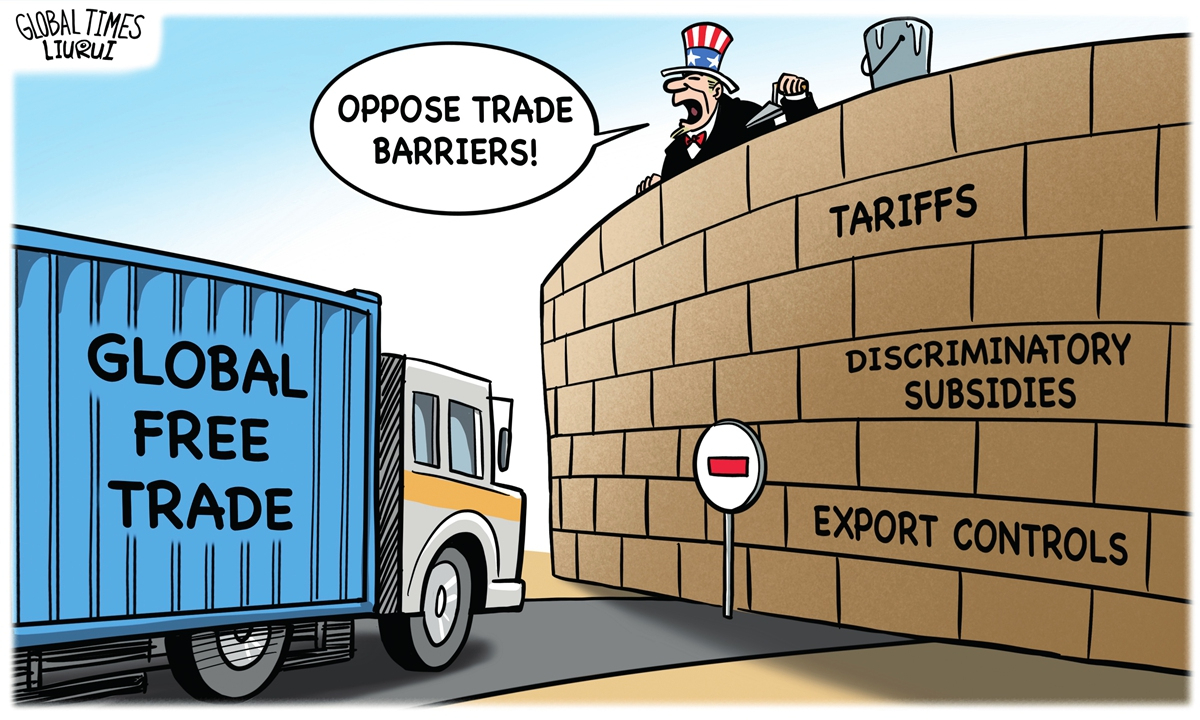
Editorial: By Closing Its Doors, Washington Puts Its Own Future at Risk
As capital from many countries flows into China at an accelerating pace, American investors constrained by their own government’s rules can only watch their window of opportunity narrow. Washington needs to listen carefully to American farmers, pharmaceutical companies and investors, and weigh the cost of its restrictions.
The U.S. Treasury Department recently released a new proposed rule on outbound investment restrictions, inviting public comments until Dec. 7. Existing restrictions cover sectors including semiconductors, artificial intelligence and quantum computing. The proposal would expand and further detail controls to cover supercomputing and hypersonic systems, while adding biotechnology to the restricted sectors. It would also list China and other nations as “countries of concern.” Responding on Oct. 24, China’s Ministry of Commerce said the discriminatory expansion and tightening of restrictions on investment in China were typical examples of overstretching the concept of national security and ran counter to the important consensus reached by the two countries’ presidents. China expressed grave concern and firm opposition, reserving the right to take corresponding measures.
Washington’s steadily tightening controls on investment in China are, in essence, an attempt to contain China’s emerging industries by overstretching the concept of national security. The executive order issued in 2023, the legislation passed by Congress in 2025 expanding the restrictions, and the latest addition of biotechnology all follow the same logic: cutting off capital flows to slow China’s technological progress. Ironically, biotechnology is one of the most active areas of mutually beneficial cooperation between the two countries. About one-third of new drugs under development worldwide originate in China. American pharmaceutical companies, including Pfizer and Bristol Myers Squibb, have signed licensing agreements worth billions of dollars with Chinese partners this year, while the U.S. pharmaceutical industry has spent months lobbying against stringent investment restrictions. Protectionism pursued in the name of security first ties the hands of American investors themselves.
The data show that Washington’s policies run counter to the investment decisions of most American companies. According to China’s Ministry of Commerce, investment from the United States, South Korea, France, Switzerland and other sources continued to grow from January through September, with U.S. investment rising 7.7%. Despite the persistent political noise, most American companies continue to demonstrate their confidence in the Chinese market through investment. Yet the 7.7% increase was markedly lower than France’s 31.8% and Switzerland’s 26%. The adverse effects of Washington’s restrictions on corporate decisions are hard to overlook. The U.S.-China Business Council’s 2026 annual report found that 95% of surveyed American companies rated their China operations as “somewhat” to “very” important to maintaining their global competitiveness. Companies are choosing to invest in China, while Washington is trying to pull them in the opposite direction.
Countries that close their doors often lose opportunities of their own. The facts repeatedly bear this out. According to the U.S.-China Business Council, U.S. exports to China fell 26% last year. The number of American jobs supported by those exports declined by an estimated 148,000. Among American companies affected by U.S. export controls, 61% lost market share to competitors. International Data Corporation projects that Washington’s trade restrictions could leave the U.S. humanoid robotics market nearly 60% smaller by 2030 than it would otherwise have been. “Once markets are lost, they are hard to regain,” America’s own business community has warned. Meanwhile, foreign investment in China’s high-tech industries grew 33.8% from January through September, and reinvestment of foreign investors’ profits rose 4.7% year over year. China’s vast market continues to grow in appeal. As capital from many countries flows into China at an accelerating pace, American investors constrained by their own government’s rules can only watch their window of opportunity narrow.
Mutual benefit lies at the heart of China-U.S. economic and trade relations. Efforts to politicize commercial issues and stretch the concept of national security must not be allowed to damage the broader bilateral relationship. A proposed rule should not work against the direction set by the two countries’ presidents or weaken the ties their business communities have worked so hard to build. China-U.S. cooperation matters to the well-being of both peoples, the stability of global industrial and supply chains and world economic growth. Labeling normal business activities a “threat” and using capital flows as a weapon undermine not only corporate confidence but also the foundations of the international economic and trade order.
The proposal remains open for public comment, and its final text has yet to be settled. The reasoned arguments of American businesses deserve to be heard. While reserving the right to take countermeasures whenever necessary, China will continue to pursue high-standard opening-up to offset external uncertainty. As China opens further, “investing in China is investing in the future” will ring increasingly true. Washington needs to listen carefully to American farmers, pharmaceutical companies and investors, and weigh the cost of its restrictions. Restrictions intended to hold others back often end up tying the hands of those who impose them. China and the United States both gain from cooperation and both lose from confrontation. Washington would do well to reconsider that simple truth.
Previous article