Time for Sincerity from US in Trade Talks with China
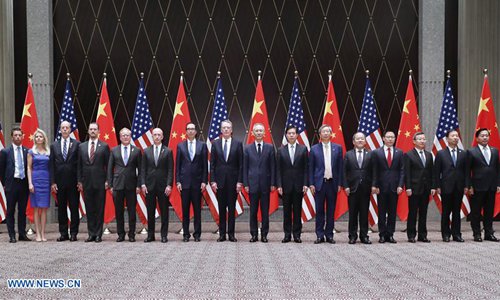
The China-US high-level trade consultations resumed Tuesday in Shanghai after about three months, which is a positive step taken by the trade negotiation teams of both countries to implement the consensus reached by the two-state leaders at the Osaka summit. However, On Tuesday evening Beijing time, the US side made discordant sound, piling more pressure on China.
The US often makes unconstructive remarks when China-US trade talks are about to start. This seems to have become a habit of Washington when dealing with China. But it is obviously not a good style. The experience of the past one and a half years has fully demonstrated that the US tactic of carrot-and-stick with Beijing at such crucial and sensitive times has never worked.
The latest message is nothing new, such as claiming that "China is doing very badly, the worst year in 27," and "China has lost 5 million jobs due to the Trump tariffs." Are we unclear about China's economic situation that we need Washington to tell us?
China's economy is stable and full steam ahead, giving China the confidence not to make unconditional concessions. The US repeatedly says China's economy is doing "badly," sending us a signal that Washington is more anxious to reach a deal than China.
The White House complained Tuesday that China "was supposed to start buying our agricultural product now - no signs that they are doing so." But the National Development and Reform Commission said Sunday that progress in purchasing US agricultural products is being made. Instead, China should remind the US to fulfil its commitments, including lifting the sanctions on Huawei.
Furthermore, the White House says Beijing is waiting for the results of the 2020 US presidential elections and hoping Democrat Joe Biden wins, and then this country will continue to plunder the US. These messy allegations are White House's speculation. Should the 2020 US elections greatly affect whether China and the US can reach a trade deal? China is negotiating with the US, not the Republican Party.
All over the world, it is the US, not China, that has become the most difficult country to deal with on trade. The US has overthrown too many agreements and rules. How can the White House say China always changes the deal in the end to its benefit? It sounds like the US is talking about itself.
China-US trade talks have been on and off since last year. If the US side thinks it can realize its goal by bluffing, things will be much easier for Washington. But it is not the case.
The White House is anxious to reach a trade deal with China since it keeps talking about the issue. Then both sides should be honest and sincere, trying to seek common grounds on the sticking points. Maximum pressure has been abused before and its effect is declining. Both sides need to attach importance to each other's major concerns. Sincerity will be the key to breaking the deadlock between Beijing and Washington.
The US has to change its bad habit of using tough talk to cheer on its negotiating team, which easily undermines the fragile mutual trust between China and the US. The US needs to build a positive image as being credible and reasonable, which may be more effective than applying maximum pressure on negotiating partners.
Previous article
Next article