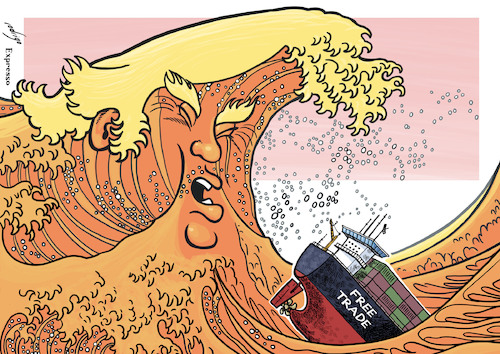
Donald Trump, the master of surprise, shocked the world when he announced that the United States would withdraw from Syria. This stunning moment was indicative of what would follow. Why did Trump betray the Kurdish allies? Why did he abandon the one side in Syria that is truly fighting the Islamic State? Why did he abandon the side that is addressing, in words and deeds, the geographic expansion linking Iran in the east, passing through Iraq, northeastern Syria, Syria's "useful" coast in the north, and the basin of Barada and the Qalamun Mountains from the south?
What strategic fruits did America reap from this withdrawal? And what did Iran and Syria gain from this American withdrawal? How does this action align with Trump and Mike Pompeo’s clear plan to blockade and weaken Iran?
All of this aside, what is the future of the international alliance fighting the Islamic State group in Syria? Noticeably, it is the Syrian Democratic forces and their authorities in the northeastern part of Syria who defeated the Islamic State group and imprisoned thousands of its dangerous elements.
Abdul Karim Omar, head of the Department of External Relations in northern and eastern Syria, told Asharq Al-Awsat that nearly 6,000 members of the Islamic State group, 1,000 of whom are from western countries, are trapped in the region east of the Euphrates. Nearby are nearly 12,000 women and children from other countries in refugee camps in the region. According to Omar, there are 4,000 women and 8,000 children from European and foreign countries.
A Syrian Democratic Forces source told Deutsche Presse-Agentur, “We are worried that the situation will get out of control, and that these ISIS members will return to the cells to which they belong, and that they may go to other countries.” Trump’s action is truly incomprehensible. It is opposed by both Republicans and Democrats, Europeans and Arabs, and those who oppose the Turkish terrorist invasion of Syria. (Inside Syria, Recip Tayyip Erdogan’s supporters of this invasion include remnants of al-Qaida and the Muslim Brotherhood). The only Arabs who support the invasion of Sultan Erdogan are Qatari authorities and activists in the Muslim Brotherhood.
A person can be so defeated during times of adversity that he sees good in things that are not.
This post appeared on the front page as a direct link to the original article with the above link
.
Officials and institutions in both countries, across all fields and at every level, must follow through on the important understandings reached by the two presidents.